 Loading... Please wait...
-
Call us on (973) 810-2976
- My Account
- Gift Certificates
- Items / $0.00
All prices are in All prices are in USD
Categories
- Home
- Identified Artifacts
- VERY RARE – Tavern Mug from the 1600s, with gold gilding
- Home
- Non-excavated Artifacts
- VERY RARE – Tavern Mug from the 1600s, with gold gilding
- Home
- Personal Items
- VERY RARE – Tavern Mug from the 1600s, with gold gilding
- Home
- Late 18th Century / Early 19th Century
- VERY RARE – Tavern Mug from the 1600s, with gold gilding
- Home
- Revolutionary War items
- VERY RARE – Tavern Mug from the 1600s, with gold gilding
- Home
- Antiques from the 18th and 19th century
- VERY RARE – Tavern Mug from the 1600s, with gold gilding


VERY RARE – Tavern Mug from the 1600s, with gold gilding

Product Description
I have spoken about the early tankard collection in previous emails and am starting to list them and included a picture of some that will be offered. I was fortunate to acquire a collection of 18th century tankards, pitchers, and tavern mugs. Some may look at them as just utilitarian drinking vessels, but they are unique in their size, material, color, and design.
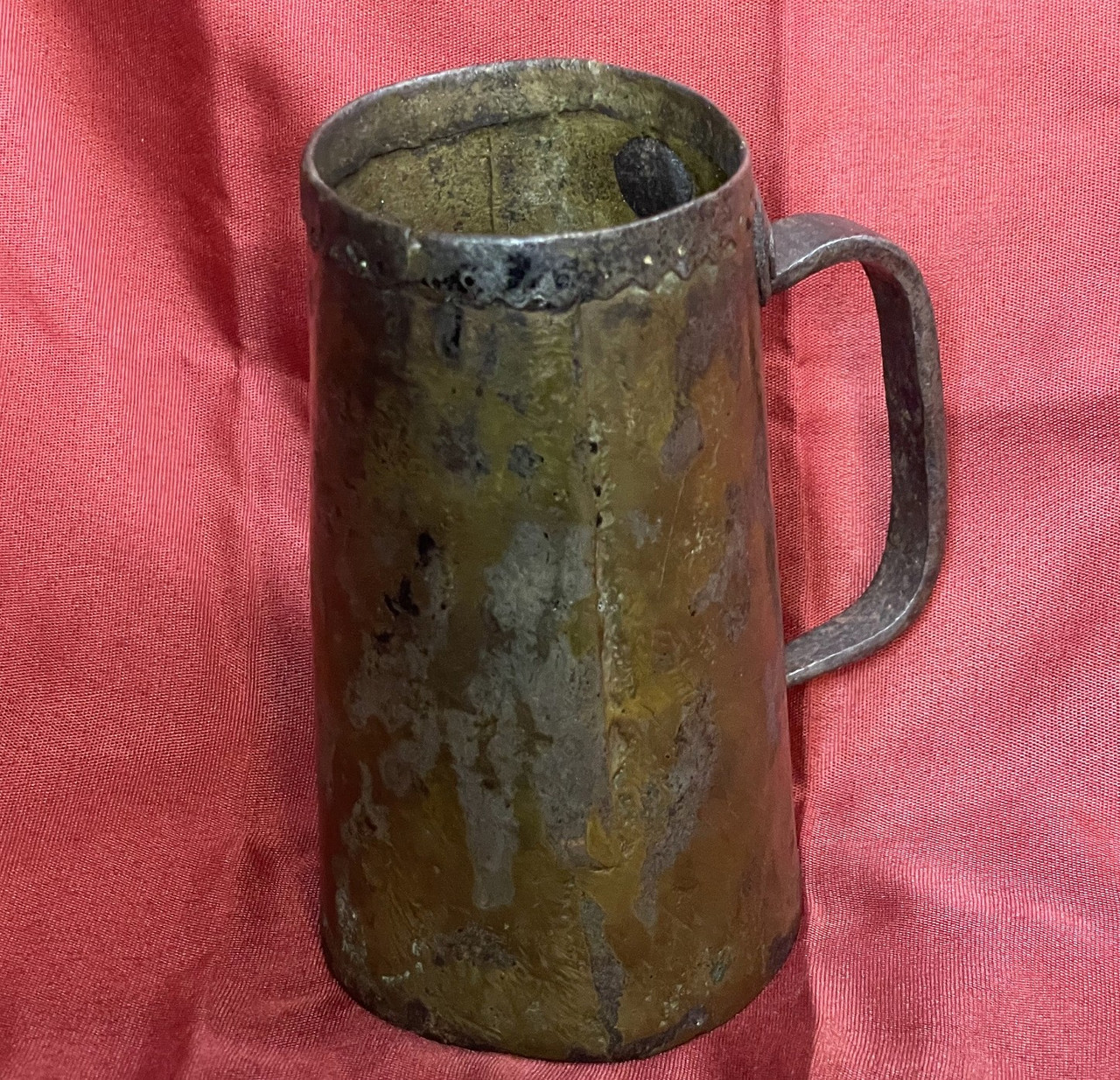
Being offered here is one of the rarest in the collection, it is an iron-forged tavern tankard, ca. 1640 – 1710. It stands 5 ½” high, a diameter of 3” on the bottom, and 2 ½” on top. It has a crudely attached handle on the side and has a scalloped trim on the top rim. This piece is rare by itself, but what is even rarer is the gold-wash that was applied.
During the manufacturing process, a paste made of gold and liquid mercury was brushed onto the mug by hand. The piece was then heated over an open fire to vaporize the mercury, leaving the gold fused to the metal surface. The liquid mixture often pooled unevenly in recessed areas, corners, or details, creating a characteristic texture known as "mercury bloom" that can look splotchy today.
Soldiers during this time period consumed high amounts of alcohol, (estimated at three times modern levels), partly due to unsafe water, with rations frequently including rum, whiskey, and spruce beer. Daily alcohol rations (roughly a "gill" or half-cup) were standard, and soldiers often looted alcohol, considering it a "spoils of war" right.
Revolutionary War soldiers, officers, and political leaders frequently visited local taverns, which served as essential hubs for military intelligence, recruiting, socializing, and lodging. Taverns operated as the "beating heart" of 18th-century life, acting as informal town halls, post offices, and, crucial to the war effort, planning centers for upcoming maneuvers.
This piece is in very nice condition and still solid. Over three hundred years of handling, washing, and polishing, the gold layer naturally wears away, leaving patchy, spotty islands of gold where the base metal shows through. This would be a center-piece of any collection, and I am sure many museums would like to add it to their collection. There may be more, but this is the only one that I have ever seen.
Product Reviews
)