 Loading... Please wait...
-
Call us on (973) 810-2976
- My Account
- Gift Certificates
- Items / $0.00

All prices are in All prices are in USD
Categories
- Home
- Sold, Hold, Layaway items
- VERY RARE! Identified Revolutionary War Tinder Box that belonged to Colonel Adams, who fought in many battles during the war (SOLD)
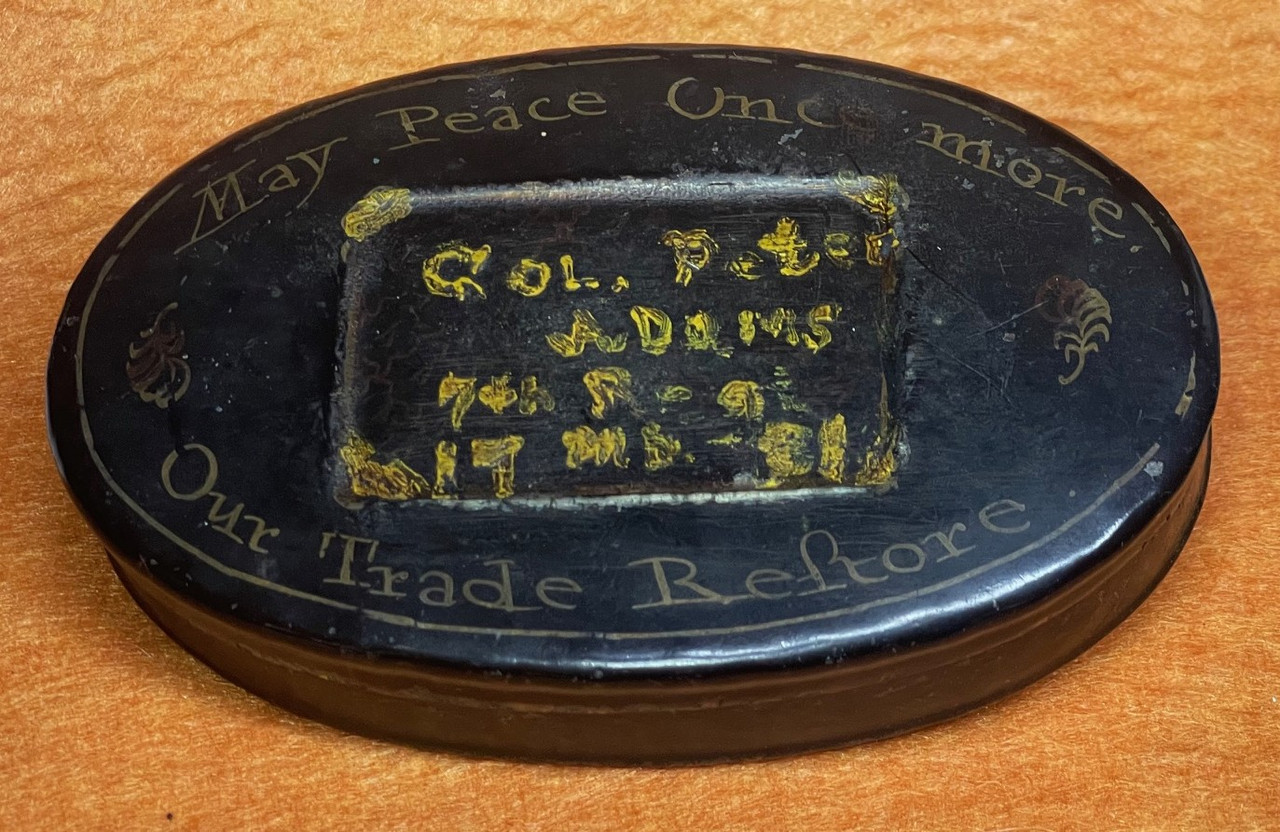


VERY RARE! Identified Revolutionary War Tinder Box that belonged to Colonel Adams, who fought in many battles during the war (SOLD)

Out of Stock
Product Description
This is a very rare, identified artifact being offered, it is a Revolutionary War Tinder Box, complete with striker, flint, and patches. It is made of tin with a top and bottom that snap together. In gold writing around the perimeter is “May Peace Once More / Our Trade Restore”. The center of the lid has a rectangular recess and in gold period writing is “Col. Peter / Adams / 7th Regt / 17 MD 81”.
Adams was an officer in the Maryland Line during the Revolutionary War. Named a captain in early 1776, he stayed in the army until the very end of the war, rising to lieutenant colonel. Along the way, he saw combat at some of the war's fiercest battle, including Brooklyn, Brandywine, Germantown, and Camden.
In January 1776, Adams was one of the captains of the First Maryland Regiment, the state's first full-time, professional soldiers, raised to meet the state's quota of soldiers for the Continental Army. As a captain, in command of the Sixth Company, Adams was expected to recruit about 70 men, as well as put up his own money to help outfit them (although he could expect to be reimbursed).
The spring and summer of 1776 were spent training the new soldiers, virtually none of whom had ever served in the army before. However, in April Adams was dispatched to Chestertown, across the Chesapeake Bay from Annapolis, to arrest a British agent named Alexander Ross. Ross was carrying papers from British Secretary of State Lord Germain and Lord Dunmore, colonial Governor of Virginia, both of whom were aggressively moving to suppress the American Revolution. Adams was one of the officers who detained Ross, and brought him first to Annapolis, then to Congress at Philadelphia.
In July, the First Maryland Regiment was ordered to march north to New York, to protect the city from invasion by the British. On August 27, 1776, the Americans faced the British Army at the Battle of Brooklyn (sometimes called the Battle of Long Island), the first major engagement of the war. The battle was a rout: the British were able to sneak around the American lines, and the outflanked Americans fled in disarray.
As the Maryland troops fought their way towards the American fortifications, they were forced to stop at the swampy Gowanus Creek. Half the regiment was able to cross the creek and escape the battle. However, the rest, including Adams's company, were unable to do so before they were again attacked by a group of British soldiers.
Facing down a much larger, better-trained force, these Marylanders, today called the "Maryland 400," mounted a series of daring charges. They held the British at bay for some time before being overrun, at the cost of many lives, losing 256 men killed or captured. Their stand bought valuable time for the rest of the American army to escape to safety.
The surviving Marylanders fought on through the rest of 1776. They continued to demonstrate their skill and bravery at battles like Harlem Heights in September and White Plains in October, but the Americans were nevertheless pushed out of New York, and by November were put on the run through New Jersey. Not until late that winter did the Continental Army secure revitalizing victories at Trenton and Princeton.
At the end of 1776, Maryland increased its contribution to the Continental Army from one regiment to eight, and Adams was promoted to lieutenant colonel of the newly-created Seventh Maryland Regiment. During the years that followed, the Maryland troops continued to prove their worth, performing their duties well. Still, the Continental Army endured several years of defeat.
In 1777, the Maryland troops took heavy casualties at the disastrous raid on Staten Island. During 1777-1778, the British and American troops vied for control over the American capital at Philadelphia. As part of the campaign, the American troops suffered two losses at Brandywine (September 1777) and Germantown (October 1777), and a limited victory at Monmouth (June 1778). In August of 1779, Adams was named lieutenant colonel commandant of the First Maryland Regiment, a promotion he had been seeking for years.
In April 1780, the Marylanders were part of the American army that marched from Pennsylvania to South Carolina to counter the British. On August 16, 1780, at the first battle of the campaign, the Americans suffered a terrible defeat at the Battle of Camden, which ended in a chaotic American retreat. The Marylanders took particularly heavy casualties, losing some 600 men--about one-third of their troops. The battle nearly destroyed the army, and the Maryland Line had only enough men to form a single regiment. After it was consolidated, a number of officers were left without a command, including Adams. He was placed in charge a new Third Maryland Regiment and was sent back to Maryland to help rebuild the army.
Finally, on August 28, 1781, Adams and his fully manned and outfitted regiment departed Annapolis. the Third stopped at Yorktown, Virginia around the end of September, and joined the Continental Army's siege of the British and were present when Cornwallis surrendered on October 17, 1781. Adams's men spent most of 1782 in South Carolina with the rest of the Marylanders, holding the remaining British troops at Charleston at bay. Around the end of the year, they returned to Maryland. Adams left the army in April 1783, more than seven years after he joined.
Product Reviews
, $665.00 (https://www.yankeerebelantiques.com/very-rare-identified-revolutionary-war-tinder-box-that-belonged-to-colonel-adams-who-fought-in-many-battles-during-the-war-sold/))