 Loading... Please wait...
-
Call us on (973) 810-2976
- My Account
- Gift Certificates
- Items / $0.00

All prices are in All prices are in USD
Categories
- Home
- Sold, Hold, Layaway items
- Shell section from a Cuttoe Sword, recovered at Crown Point, NY (SOLD)
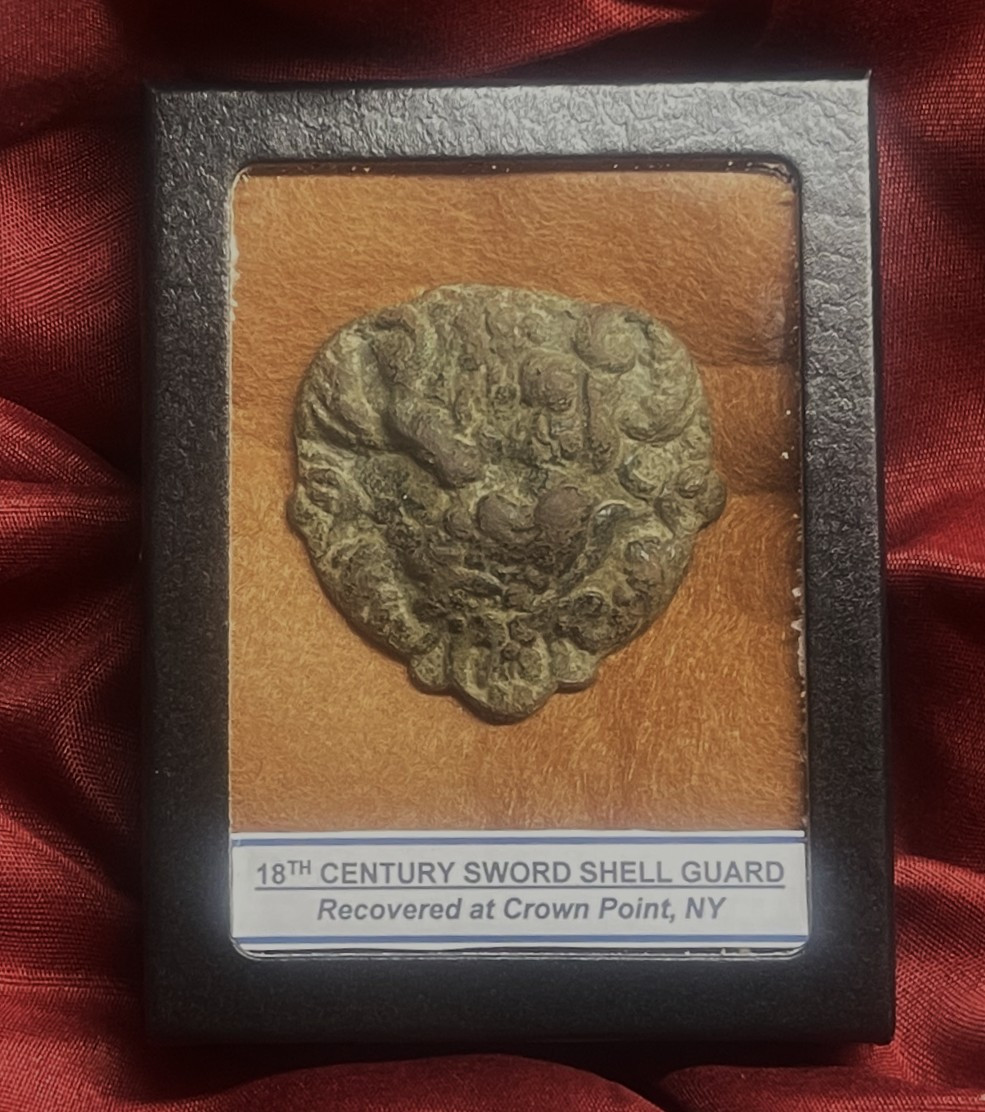


Shell section from a Cuttoe Sword, recovered at Crown Point, NY (SOLD)

Out of Stock
Product Description
This is a rare piece being offered, it is the brass shell section from an 18th century Cuttoe, measuring 2 ½” x 2”. A Cuttoe is a short, single-edged hunting sword or hanger popular in Europe and the American colonies during the 17th and 18th centuries. Derived from the French couteau de chasse (hunting knife), these weapons were frequently carried by officers and militiamen as both a badge of rank and a practical close-combat tool. It was recovered many years ago at Crown Point, NY.
At the outbreak of the American Revolution, the rebellious colonists looked to Crown Point to aid their cause. The surrender of Fort Crown Point to American rebel troops commanded by Seth Warner in May of 1775 yielded 114 pieces of cannon and heavy ordnance sorely needed by the Americans. Colonel Henry Knox carried twenty-nine of these to Boston during that winter to force the British out of the city.
After the capture of the fort, Crown Point became a springboard for an invasion of Canada. General Richard Montgomery's force sailed down the lake in August 1775. Despite initial success in Montreal, the combined forces of Montgomery and Benedict Arnold were defeated at Quebec in December 1775. They retreated in disarray, riddled with smallpox, to Crown Point. Men died by the hundreds in makeshift field hospitals and were buried in mass graves.
Crown Point was a staging area for the British in both 1776 and 1777. After the Americans abandoned Crown Point, the British assembled their troops here. Delayed by the American Navy, Sir Guy Carleton arrived here with his troops in October of 1776 but retreated north for the winter shortly thereafter. British General John Burgoyne's army arrived here in June of 1777. Crown Point remained under British control until the end of the war.
There are examples of these swords in the “Collector’s Illustrated Encyclopedia of the American Revolution” by Neumann & Kravic and in “Swords & Blades of the American Revolution” by George Neumann (see pictures). It remains in very nice condition, solid with no flaking or chipping. It comes in the glass top display case pictured.
With the 250th anniversary of the nation's founding this year, interest in the Revolutionary War and its relics is significantly increasing. This renewed enthusiasm is driving the demand for virtually all Revolutionary War artifacts, further contributing to their scarcity and rising prices.
I am witnessing a notable uptick in purchases of these items, which reflects the growing celebrations for the anniversary and the heightened value of Revolutionary War memorabilia.
Product Reviews
, $145.00 (https://www.yankeerebelantiques.com/shell-section-from-a-cuttoe-sword-recovered-at-crown-point-ny-sold/))