 Loading... Please wait...
-
Call us on (973) 810-2976
- My Account
- Gift Certificates
- Items / $0.00

All prices are in All prices are in USD
Categories
- Home
- Identified Artifacts
- Revolutionary War soldier’s pocketknife, dug at Fort Haldimand, NY
- Home
- Excavated Artifacts
- Revolutionary War soldier’s pocketknife, dug at Fort Haldimand, NY
- Home
- Personal Items
- Revolutionary War soldier’s pocketknife, dug at Fort Haldimand, NY
- Home
- Late 18th Century / Early 19th Century
- Revolutionary War soldier’s pocketknife, dug at Fort Haldimand, NY
- Home
- Revolutionary War items
- Revolutionary War soldier’s pocketknife, dug at Fort Haldimand, NY
- Home
- Antiques from the 18th and 19th century
- Revolutionary War soldier’s pocketknife, dug at Fort Haldimand, NY
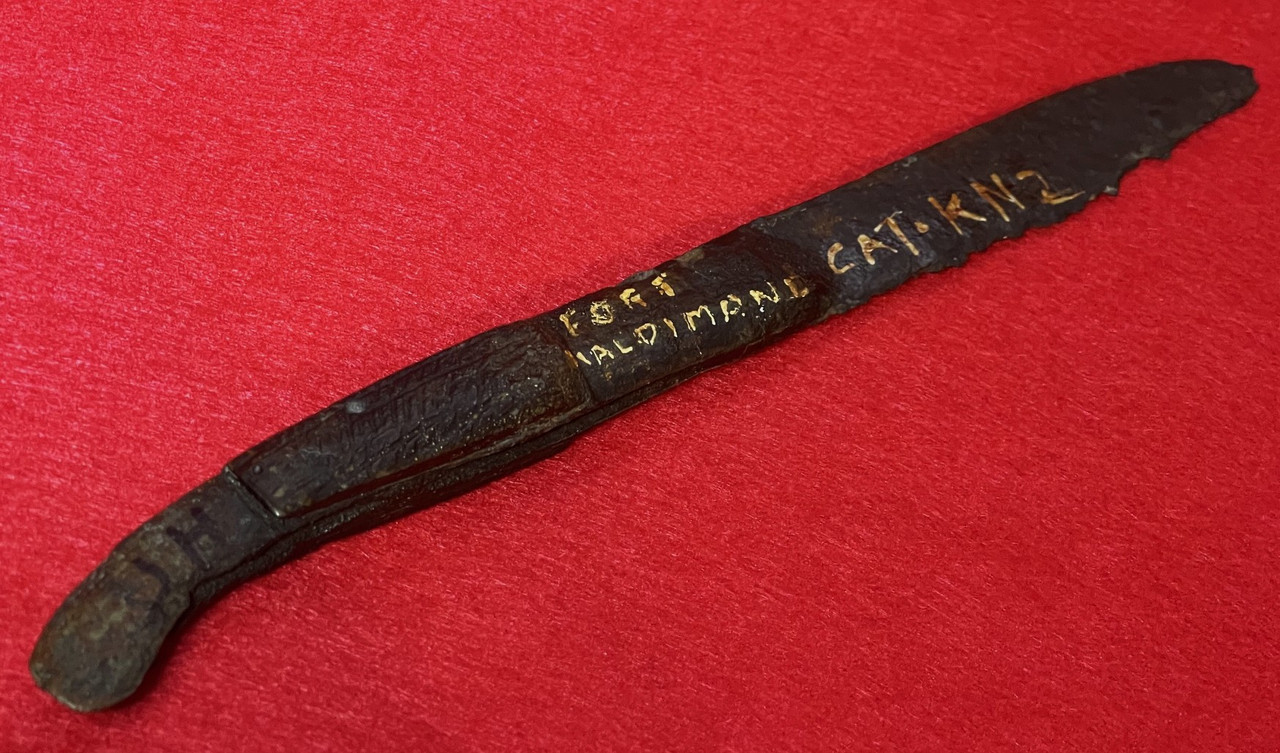


Revolutionary War soldier’s pocketknife, dug at Fort Haldimand, NY

Product Description
This is another early piece coming out of a 60-year collection of French & Indian War and Revolutionary War artifacts. Being offered is a Revolutionary War soldier’s pocketknife, measuring 8” x ¾”. It is frozen in the open position, and the wooden handle is mostly intact. At the end of the handle there is a faint black marking with what appears to be “UH”. Also on the blade is a museum or inventory marking. These knives are in the Colonial Williamsburg Museum and the Fort Ticonderoga Museum (see pictures).
It was recovered at Ft. Haldimand, NY many years ago. Located near the head of Carleton Island, Fort Haldimand was built in 1777 as a staging area for the British during the American Revolution. Molly Brant, a Mohawk leader who worked to keep the Iroquois Confederacy loyal to the British during the war, lived at Fort Haldimand for a time.
Fort Haldimand was a British Revolutionary War fort initially established as Fort Carleton in 1778 under the supervision of Captain Thomas Aubrey on Carleton Island in Jefferson County, New York. Initially named for Sir Guy Carleton, Governor of Canada, and Commander of British forces in Canada. Renamed Fort Haldimand for Sir Frederick Haldimand, Carleton's replacement. Construction was halted in 1783, and the post was abandoned in 1812.
This is the typical pocketknife carried by most Revolutionary War soldiers on both sides. Although it has overall rust, it has been coated for preservation and is very solid. There are examples in “Collector’s Illustrated Encyclopedia of the American Revolution”, by Neumann and Kravic. Also, there are examples of dug and non-dug pocket knives in just about all of the Revolutionary War museums (see pictures). It is rare to find these knives in this condition for being in the ground for centuries.
****************************************
Throughout history, war has been a constant presence, shaping civilizations and societies. From the earliest days of humanity, conflict has persisted in various forms, and based on historical patterns, it is likely to continue in some manner. This ongoing reality has given rise to a deep fascination among historians and collectors who seek to understand the past through the tangible remnants left behind, i.e. uniforms, guns, swords, artillery.
While significant attention is given to weapons and military gear, the everyday items used by soldiers frequently go unnoticed. Simple objects like forks, spoons, cups, dishes, pots, and knives played an essential role in a soldier’s daily life. These items were as precious to the individual as their weapon, serving practical needs and providing comfort amidst the hardships of war. I myself have always appreciated their importance in showing a complete representation in a collection. Bob
Product Reviews
)