 Loading... Please wait...
-
Call us on (973) 810-2976
- My Account
- Gift Certificates
- Items / $0.00

All prices are in All prices are in USD
Categories
- Home
- Sold, Hold, Layaway items
- Revolutionary War soldier’s Belt Axe, recovered at Saratoga, NY (SOLD)
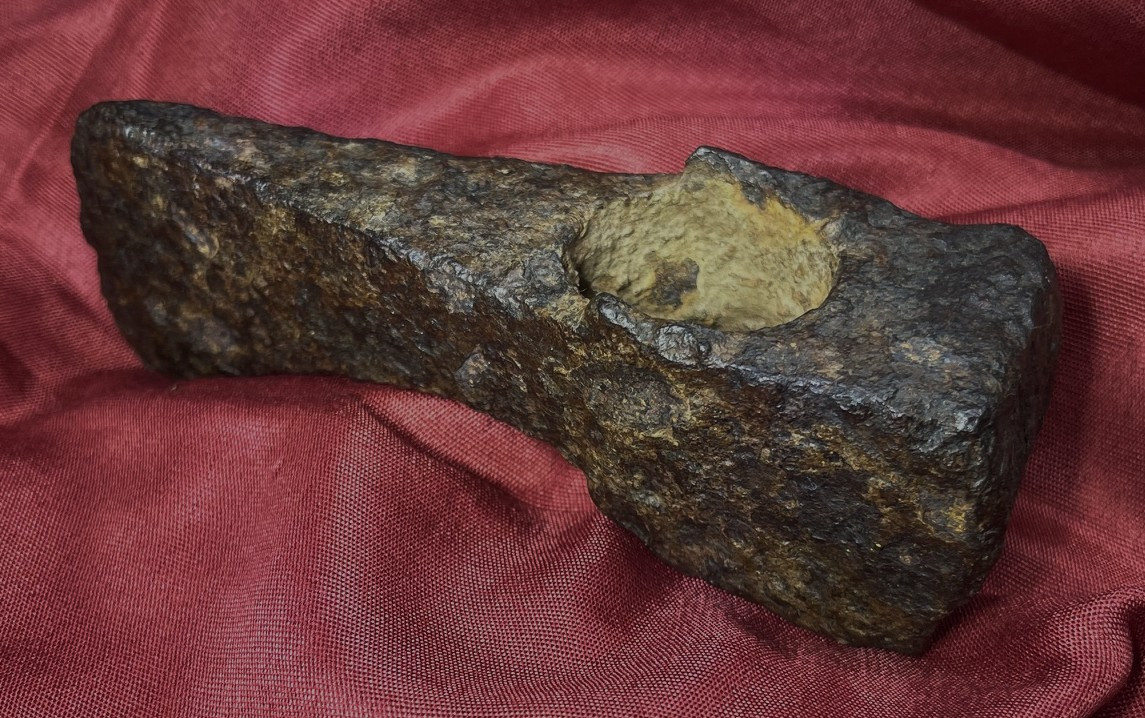


Revolutionary War soldier’s Belt Axe, recovered at Saratoga, NY (SOLD)

Out of Stock
Product Description
This is another rare piece being offered; it is the iron head from a Revolutionary War soldier’s belt axe, measuring 5 1/4” x 1 3/4” x 1 3/4”. In the 1700s, the terms "belt axe" and "tomahawk" were often used interchangeably. Generally, belt axes were heavier, general-purpose chopping tools with hammer poles, favored by European troops. Tomahawks were usually lighter, hybrid tools/weapons. It was recovered many years ago from the fighting at the Battle of Saratoga, NY.
In 1777, British war generals devised a plan to bring a quick end to the war: They would effectively sever New England from the rest of the colonies by taking control of New York City, Albany, and the Hudson River. First, British General John Burgoyne would lead 8,000 troops from Canada. Barry St. Leger would direct his troops east from Lake Ontario, and General Howe would move his troops north from New York City, where all three would meet at Albany to destroy the Rebel armies.
Burgoyne’s army soon became trapped in Saratoga, blocked in the south by Patriot General Horatio Gates’ army (see picture). Howe’s army remained in Philadelphia, and St. Leger’s Army was defeated at Fort Stanwix. On October 7, 1777, Burgoyne made a desperate attempt to attack the larger Patriot force at Saratoga which now comprised the armies of both Gates and Benedict Arnold.
Despite initial success at Freeman’s Farm, Burgoyne’s Army would be routed by Arnold’s at Bemis Heights. Beset by a lack of supplies and horrendous casualties, Burgoyne had no choice but to surrender (see pictures). The battle of Saratoga was one of the most important battles during the Revolution.
There are examples of this axe in the “Collector’s Illustrated Encyclopedia of the American Revolution”, by Neumann and Kravic and in and in “Swords & Blades of the American Revolution” by Neumann (see pictures). This is the first time it has been on the open market and is truly a great piece of early American History. It definitely merits a place in an advanced collection or museum. Any relic from Saratoga has been very difficult to find.
With the 250th anniversary of the nation's founding this year, interest in the Revolutionary War and its relics is significantly increasing. This renewed enthusiasm is driving the demand for virtually all Revolutionary War artifacts, further contributing to their scarcity and rising prices.
I am witnessing a notable uptick in purchases of these items, which reflects the growing celebrations for the anniversary and the heightened value of Revolutionary War memorabilia.
Product Reviews
, $345.00 (https://www.yankeerebelantiques.com/revolutionary-war-soldier-s-belt-axe-recovered-at-saratoga-ny-sold/))