 Loading... Please wait...
-
Call us on (973) 810-2976
- My Account
- Gift Certificates
- Items / $0.00

All prices are in All prices are in USD
Categories
- Home
- Sold, Hold, Layaway items
- Revolutionary War medical grouping of basin, amputation knife, forceps, and glass blood-letting cup (SOLD)
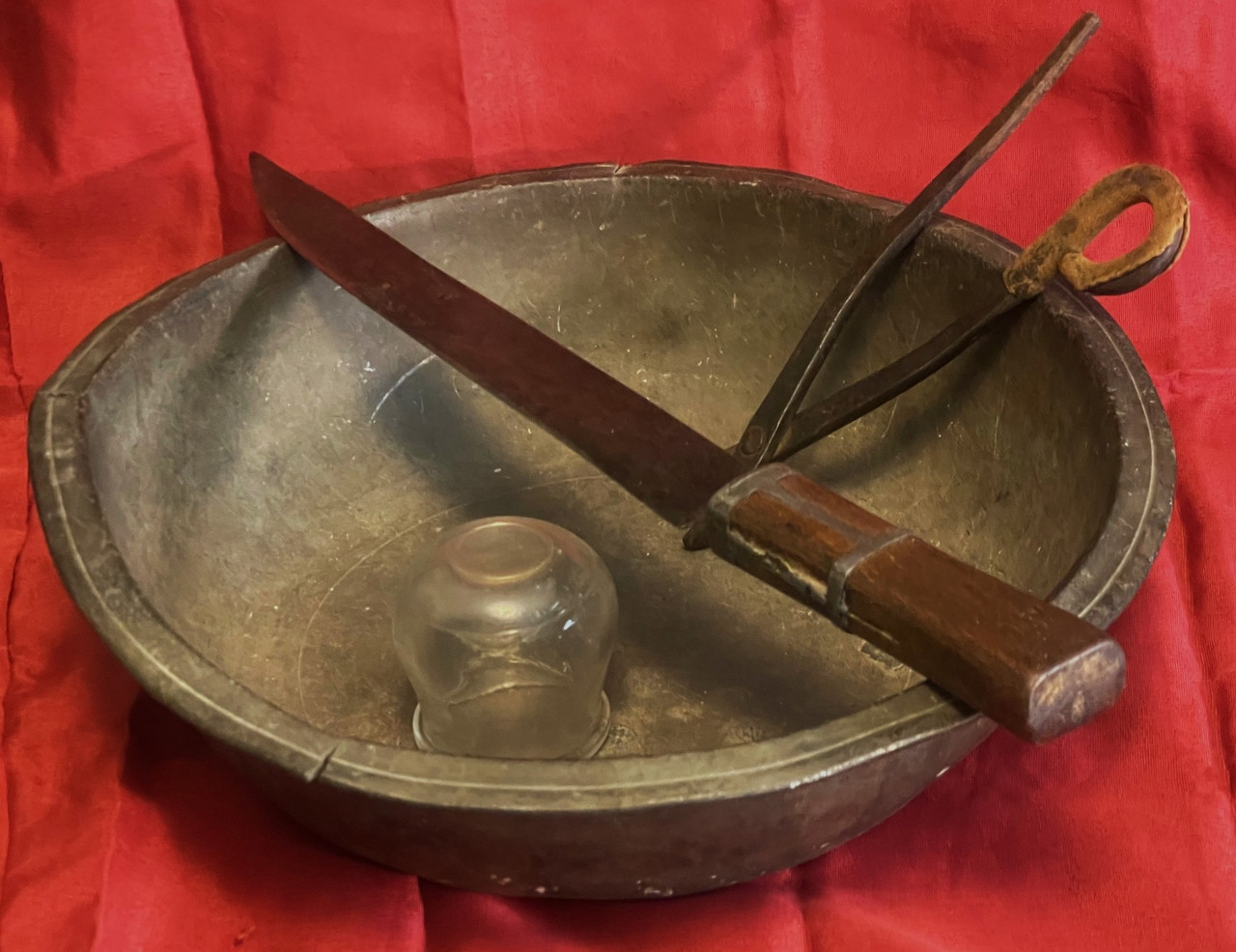


Revolutionary War medical grouping of basin, amputation knife, forceps, and glass blood-letting cup (SOLD)

Out of Stock
Product Description
A while back I acquired a large Revolutionary War collection which the majority was military, but there was still quite a bit of personal and medical items. The four pieces here were wrapped together, so I am selling them as a grouping – keeping them together as found.
The basin has a 12 ½” diameter and 3 ¼” high. I believe it is either bronze or brass because it is heavy, weighing 3-pounds, 12-ounces. The knife measures 15” overall with an 11” blade. The wooden handle has a pewter or lead inlay design. In the closed position, the forceps measure 8” x 2”. The glass bloodletting cup is 2 ¼” x 2 ½”.
The 1700s was a time when doctors did not understand the importance of sterilization, and surgery knowledge and techniques were very primitive. For severe wounds from musket balls or blades in arms and legs, amputation was the usual treatment. Worse, the surgeon’s instruments were used on multiple patients without washing or any kind of sterilizing between surgeries.
Anesthesia was likewise primitive, consisting of pain relievers such as opium and alcohol, and were often not available in the field. Patients were given something to bite on, such as a stick or leather strap, then multiple people held them down during the surgery. After the agony of having a limb cut and sawed off, performed with little or no pain relief, you likely had only a one in three chance of survival. Shock was the normal reaction, then there was blood loss and infection, all deadly.
There are examples of these items in most Revolutionary War museums and in books (see pictures).
Product Reviews
, $585.00 (https://www.yankeerebelantiques.com/revolutionary-war-medical-grouping-of-basin-amputation-knife-forceps-and-glass-blood-letting-cup-sold/))