 Loading... Please wait...
-
Call us on (973) 810-2976
- My Account
- Gift Certificates
- Items / $0.00

All prices are in All prices are in USD
Categories
- Home
- Sold, Hold, Layaway items
- Revolutionary War era Westerwald Stein circa 1730–1760, as in museums and books (SOLD)
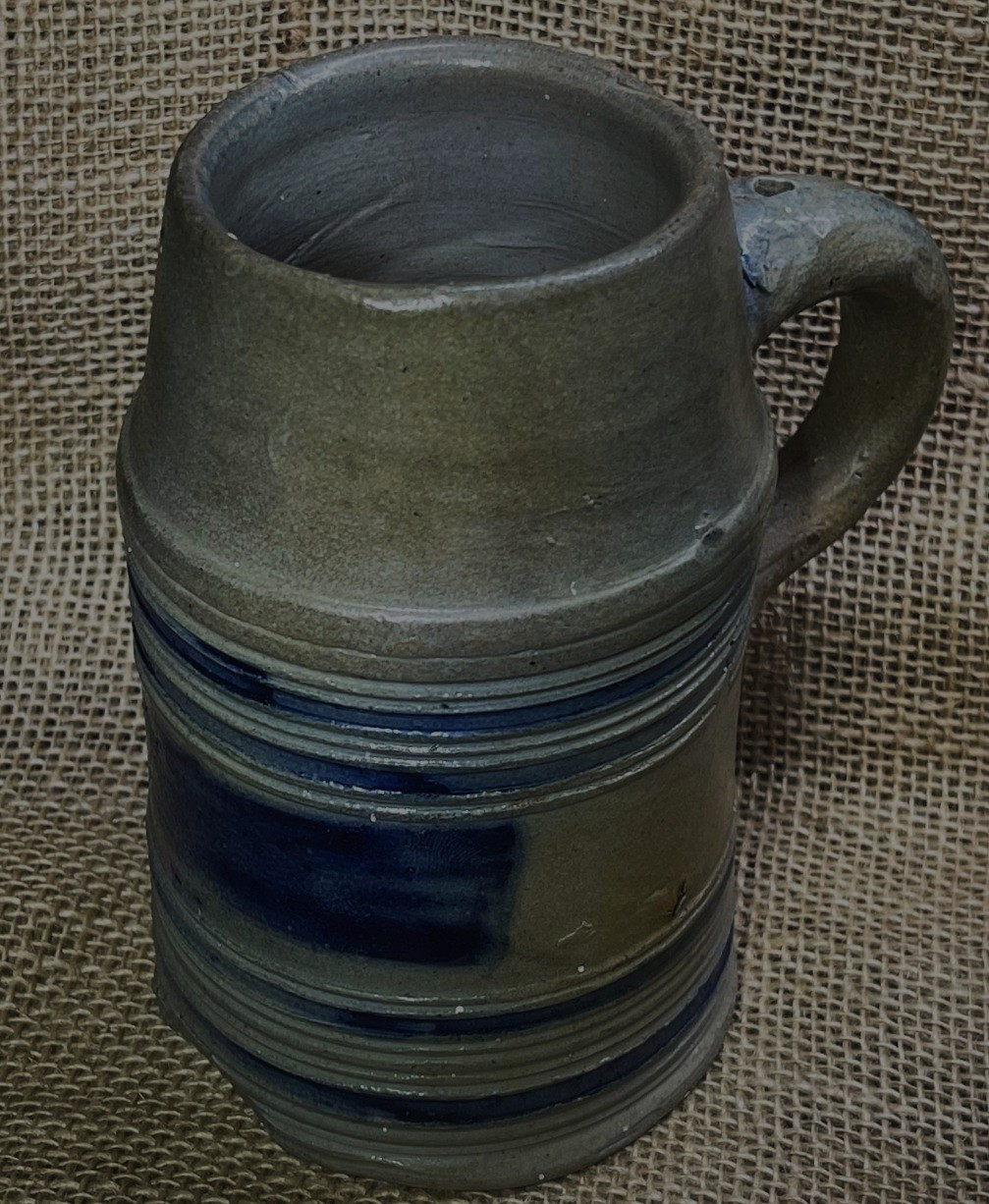


Revolutionary War era Westerwald Stein circa 1730–1760, as in museums and books (SOLD)

Out of Stock
Product Description
Being offered is one of the tankards from the email I previously sent out. It is an early piece coming out of a large Revolutionary War collection. A significant portion of this collection has been artillery related, but there are also medical and personal items.
It is an 18th century Westerwald Tavern Stein with a diameter of 3 3/4” on the bottom and 2 7/8” on the top, 6” high. The blue used on traditional Westerwald pottery is called cobalt blue. This pigment was used specifically because it is one of the few colors that can withstand the intense, high-firing temperatures of the salt-glazed kiln process.
In the late 17th century and throughout the 18th century, the Westerwald stoneware industry flourished. Crowned initials of English monarchs were common on vessels made for British markets. Westerwald stoneware was traded up the Rhine River into the Low Countries and distributed via Dutch merchants to the British Isles and beyond.
A significant increase in the number of potters in the second quarter of the 17th century led to the production of new and different forms and types of decoration, making products from the area easily recognizable. While excavating at Jamestown, Virginia, there were Westerwald jugs, tankards, and chamber pots found at the Jamestown Settlement in Virginia until 1775 (see pictures).
There are many examples of Westerwald in the Colonial Williamsburg Museum, as well as excavated pieces (see pictures). There are also fragments recovered at Fort Ticonderoga, NY (see pictures). They are also featured in “Collector’s Illustrated Encyclopedia of the American Revolution” by Neumann & Kravic (see pictures). This one is in very nice condition with great coloring. A few spots that may look like damage are only blemishes in the manufacturing process.
_______________________________________
Throughout history, war has been a constant presence, shaping civilizations and societies. From the earliest days of humanity, conflict has persisted in various forms, and based on historical patterns, it is likely to continue in some manner. This ongoing reality has given rise to a deep fascination among historians and collectors who seek to understand the past through the tangible remnants left behind, i.e. uniforms, guns, swords, artillery.
While significant attention is given to weapons and military gear, the everyday items used by soldiers frequently go unnoticed. Simple objects like forks, spoons, cups, dishes, pots, and knives played an essential role in a soldier’s daily life. These items were as precious to the individual as their weapon, serving practical needs and providing comfort amidst the hardships of war. I myself have always appreciated their importance in showing a complete representation in a collection. Bob
Product Reviews
, $235.00 (https://www.yankeerebelantiques.com/revolutionary-war-era-westerwald-stein-circa-1730-1760-as-in-museums-and-books-sold/))