 Loading... Please wait...
-
Call us on (973) 810-2976
- My Account
- Gift Certificates
- Items / $0.00

All prices are in All prices are in USD
Categories
- Home
- Identified Artifacts
- Revolutionary War Double-Crusie Lamp, as in books and museums
- Home
- Non-excavated Artifacts
- Revolutionary War Double-Crusie Lamp, as in books and museums
- Home
- Personal Items
- Revolutionary War Double-Crusie Lamp, as in books and museums
- Home
- Late 18th Century / Early 19th Century
- Revolutionary War Double-Crusie Lamp, as in books and museums
- Home
- Revolutionary War items
- Revolutionary War Double-Crusie Lamp, as in books and museums
- Home
- Early Lighting
- Revolutionary War Double-Crusie Lamp, as in books and museums
- Home
- Antiques from the 18th and 19th century
- Revolutionary War Double-Crusie Lamp, as in books and museums
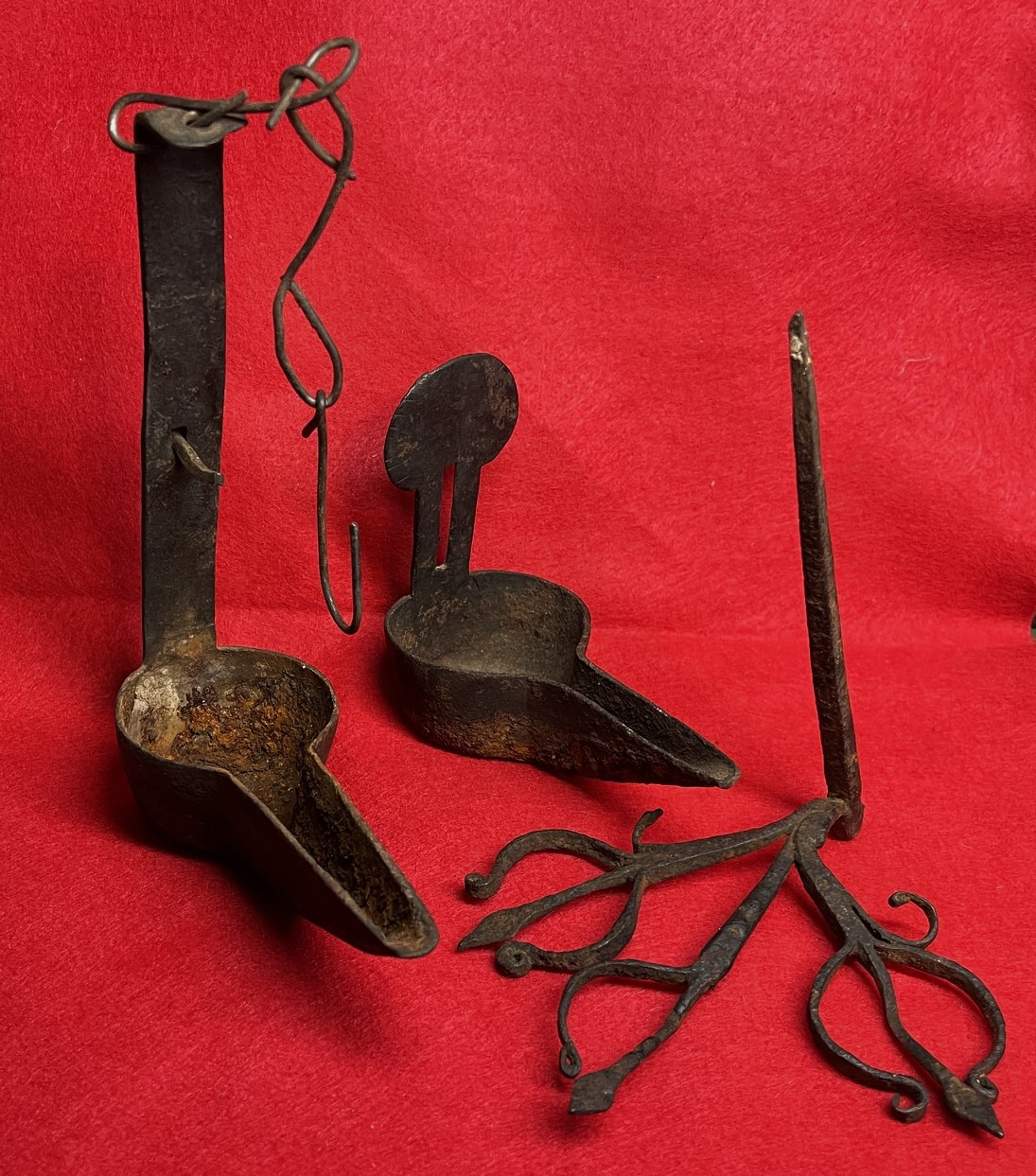


Revolutionary War Double-Crusie Lamp, as in books and museums

Product Description
Being offered is a Double-Crusie Lamp, ca. 1710-1780. The two-bowl section measures 6 ½” high x 4” x 2”. Attached to it is the crude wire chain which goes onto the original wrought iron Crusie Lamp Spike.
The primitive Crusie Lamp was popular in the 1600’s to 1700’s and still used into the 19th century by poor households. A simple lamp, the Crusie is basically a formed metal bowl to hold fuel (oil) with an indentation or channel to hold a wick. This was a durable improvement over the clay pottery lamps of ancient times.
The word “crusie” is of Scottish origin and seems to have been derived from cruse, meaning “a vessel for oil.” In Cornwall they were called chills, and in the Channel Islands they were called cressets. The designs remained the same, but some lamps had multiple channels to accept multiple wicks to increase the lighting.
Because unburned oil would drip from the wick onto the ground in waste, some examples had another bowl placed under the main bowl to catch this oil. These lamps are called Double Crusies or Phoebe Lamps. As a basic use item, Crusie Lamps were rarely ornate or made with fine metals, but there are always exceptions.
There are Crusie lamps in “Collector’s Illustrated Encyclopedia of the American Revolution” by Neumann & Kravic and in the Ticonderoga Museum (see pictures). Parts of these lamps are found at Revolutionary War sites and forts, attesting to their use throughout the period.
This is a solid piece and rarely found with the spike hanger and wire. The hanger has a small piece missing (probably for a couple hundred years), but this does not distract from the overall appearance.
With the 250th anniversary of the nation's founding this year, interest in the Revolutionary War and its relics is expected to significantly increase. This renewed enthusiasm will drive demand for virtually all Revolutionary War artifacts, further contributing to their scarcity and rising prices.
Already, I am witnessing a notable uptick in purchases of these items, which reflects the growing anticipation for the anniversary and the heightened value of Revolutionary War memorabilia.
Product Reviews
)