 Loading... Please wait...
-
Call us on (973) 810-2976
- My Account
- Gift Certificates
- Items / $0.00

All prices are in All prices are in USD
Categories
- Home
- Sold, Hold, Layaway items
- RARE – Revolutionary War cannonball recovered at Whitehall, NY (SOLD)
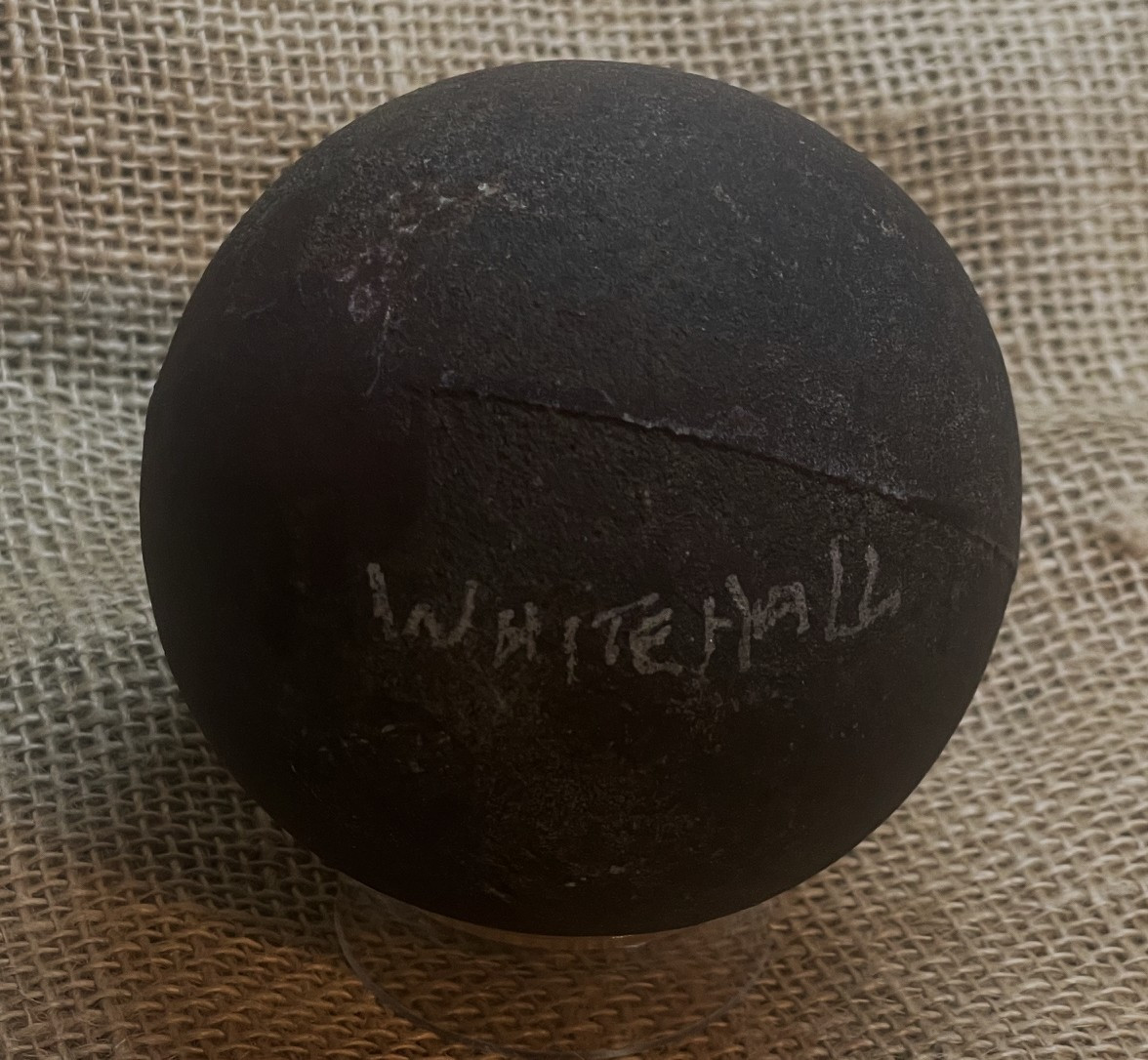


RARE – Revolutionary War cannonball recovered at Whitehall, NY (SOLD)

Out of Stock
Product Description
Being offered is a Revolutionary War 6-pounder solid-shot cannonball, probably British. It weighs 5-pounds, 6-ounces and has a diameter of 3.35”. It has a very pronounced mold-seam and shows the area where the sprue was filed down. It was recovered at Skenesborough, New York (present day Whitehall).
In the summer of 1776, General Benedict Arnold supervised the rapid construction of a small fleet of gunboats, row galleys, and gundalows at Skenesborough, which was later renamed Whitehall, New York.
Because this fleet represented the first warships built by the rebellious American colonies to confront an enemy fleet, Whitehall is widely celebrated as the "Birthplace of the United States Navy". These ships fought bravely against a superior British force at the Battle of Valcour Island on Lake Champlain on October 11, 1776.
While the battle resulted in a tactical defeat—with many of the American gunboats heavily damaged, captured, or purposefully burned and sunk to keep them out of enemy hands—the effort effectively delayed the British invasion from Canada by a full year. This extra time allowed the Continental Army to rebuild and ultimately win the pivotal Battle of Saratoga.
While retreating from Mount Independence, Col. Pierse Long’s force of mixed Continental troops and families joined forces with Capt. James Gray’s soldiers at Skenesborough. The British navy pursued and engaged the Americans at Skenesborough, while three regiments attempted and failed to cut off the route of escape for the Americans. The American forces fled south and burned their ships and supplies while retreating.
In capturing Skenesborough and other small settlements between Fort Ticonderoga and Albany, Gen. John Burgoyne intended to cut off all communication between the coast and inland New York. Burgoyne was also attempting to maintain control of the Lake Champlain region. Gen. Burgoyne’s victory at Skenesborough only added to his belief that his campaign would be a complete success.
This cannonball is in very nice condition, showing a slightly rough surface with no chipping or flaking. It also has the bonus of having both a mold seam and sprue mark. There is a near identical example of this ball that was recovered at Crown Point in 1982 (see pictures). This ball would have been fired by a British 6-pounder cannon, as shown in the Fort Ticonderoga Museum.
With the 250th anniversary of the nation's founding this year, interest in the Revolutionary War and its relics is significantly increasing. This renewed enthusiasm is driving the demand for virtually all Revolutionary War artifacts, further contributing to their scarcity and rising prices.
I am experiencing a notable uptick in purchases of these items, which reflects the growing celebrations for the anniversary and the heightened value of Revolutionary War memorabilia.
Product Reviews
, $445.00 (https://www.yankeerebelantiques.com/rare-revolutionary-war-cannonball-recovered-at-whitehall-ny-sold/))