 Loading... Please wait...
-
Call us on (973) 810-2976
- My Account
- Gift Certificates
- Items / $0.00

All prices are in All prices are in USD
Categories
- Home
- Sold, Hold, Layaway items
- Rare – French & Indian War Trade Cleaver with French marking, dug in the Mohawk Valley (SOLD)
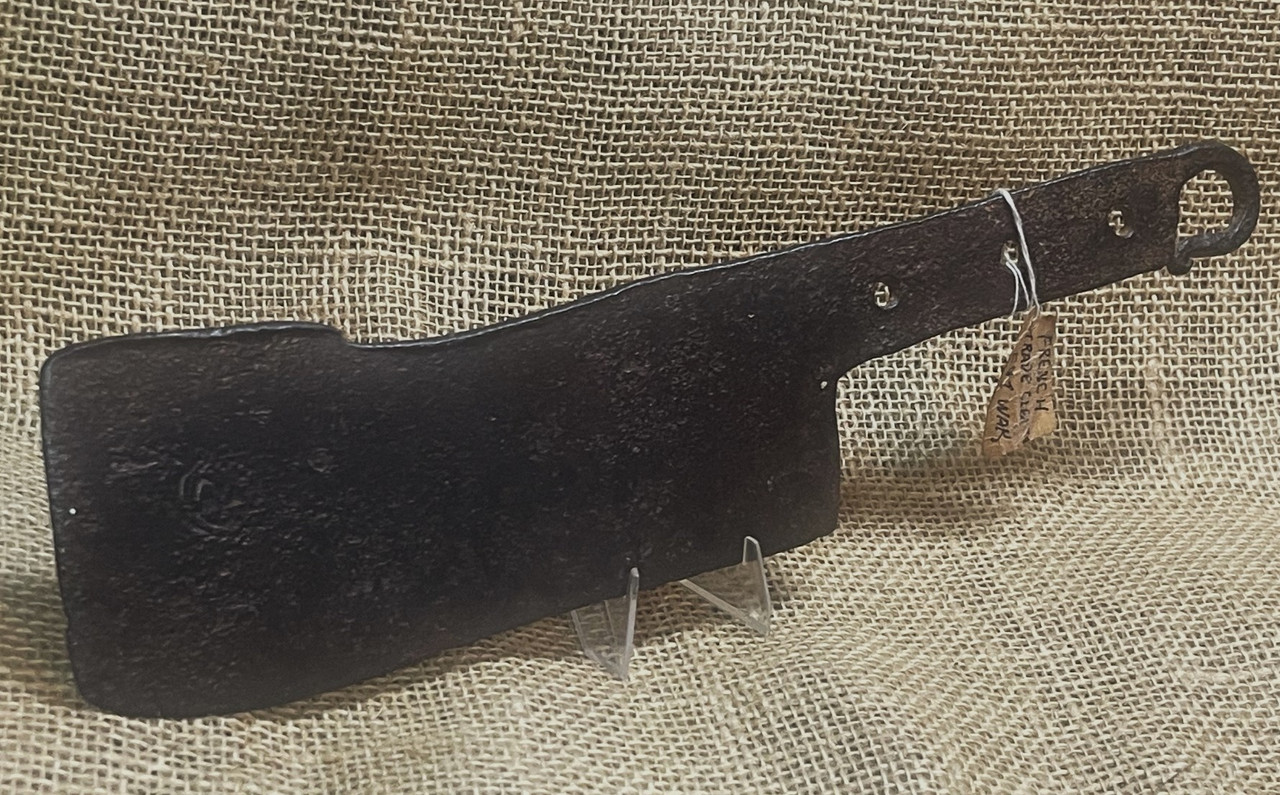


Rare – French & Indian War Trade Cleaver with French marking, dug in the Mohawk Valley (SOLD)

Out of Stock
Product Description
This is an iron cleaver which measures 11” x 3” and having a “rat tail” handle, ca. 1720 – 1740. It has a circular stamping, which appears to be French, probably the maker. It was found many years ago in Upstate New York in the Mohawk Valley region.
In the 1700s, French trading with Native Americans Indians centered on the lucrative fur trade. French voyageurs exchanged European manufactured goods like metal tools, kettles, and cloth for beaver and deer pelts, relying heavily on Indigenous alliances and kinship networks rather than mass land displacement.
During the French and Indian War (1754–1763), the Mohawk Nation—the easternmost members of the Iroquois Confederacy—lived in their traditional homeland along the Mohawk River in upstate New York. As the "Keepers of the Eastern Door," the Mohawks faced intense military pressure, strategic division, and cultural disruption as Britain and France fought for control of North America.
This unique piece is in excellent condition, showing signs of extended use, but no chipping or flaking. It has a light coating of varnish for preservation.
Product Reviews
, $225.00 (https://www.yankeerebelantiques.com/rare-french-indian-war-trade-cleaver-with-french-marking-dug-in-the-mohawk-valley-sold/))