 Loading... Please wait...
-
Call us on (973) 810-2976
- My Account
- Gift Certificates
- Items / $0.00

All prices are in All prices are in USD
Categories
- Home
- Identified Artifacts
- RARE – 18th Century Westerwald Pitcher, ca. 1760 – 1785, as in museums
- Home
- Non-excavated Artifacts
- RARE – 18th Century Westerwald Pitcher, ca. 1760 – 1785, as in museums
- Home
- Personal Items
- RARE – 18th Century Westerwald Pitcher, ca. 1760 – 1785, as in museums
- Home
- Late 18th Century / Early 19th Century
- RARE – 18th Century Westerwald Pitcher, ca. 1760 – 1785, as in museums
- Home
- Revolutionary War items
- RARE – 18th Century Westerwald Pitcher, ca. 1760 – 1785, as in museums
- Home
- Antiques from the 18th and 19th century
- RARE – 18th Century Westerwald Pitcher, ca. 1760 – 1785, as in museums
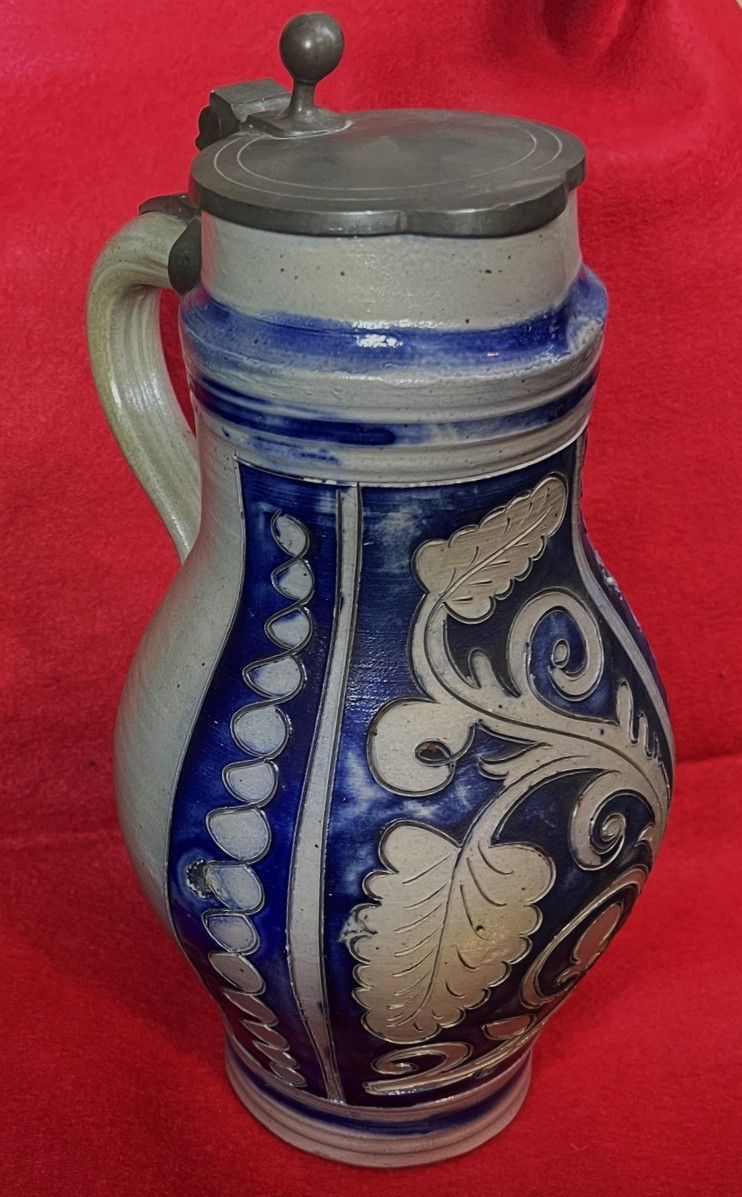


RARE – 18th Century Westerwald Pitcher, ca. 1760 – 1785, as in museums

Product Description
Recently, I traveled to the New England area to view an old large collection of Westerwald pottery. I purchased this beautiful 18th century collection and am going to keep some and start listing some of the others.
For those who might not be familiar with these artifacts, Westerwald pottery is durable, salt-glazed stoneware from the Westerwald region of Germany. Local clay mining dates back to 1402, with a massive industry boom in the late 16th century when master potters from Siegburg and Raeren immigrated there. The region produced iconic blue-grey salt-glazed jugs and tankards traded globally.
The vast and extensive clay quarries in the Westerwald region represent the largest connected deposits in Europe. Only a few other regions in the world are known to have clay sources of comparable size and quality. The Westerwald clay is distinguished by its exceptional ductility, virtually impurity-free composition, and excellent sintering properties. These clays are perfectly suited for stoneware production–a high-fired, waterproof, acid-resistant, impermeable clay.
The pitcher being offered here is a King George era piece, circa 1760 – 1785, having the pewter flip top lid. It measures 11” high overall x 3 ¼” diameter on the top, 3 1/2” on the base”, and the handle extends 2 1/2”. On the side the potter marked “1 ½”, typically denotes a capacity or size designation corresponding to early volume units (such as historical pints, mugs, or early liter equivalents), used for measuring and dispensing ale, wine, or liquor
A significant increase in the number of potters in the second quarter of the 17th century led to the production of new and different forms and types of decoration, making products from the area easily recognizable. While excavating at Jamestown, Virginia, there were Westerwald jugs, tankards, and chamber pots found in the material records of Jamestown until ca.1775 (see pictures).
The Westerwald stoneware vessels recovered from James Fort were brought from England with their wealthy owners. Objects of a later date, however, may have been obtained directly from Dutch trading vessels. There are many examples of Westerwald and shards in the Colonial Williamsburg Museum (see pictures).
The pitcher remains in very nice condition, having no chips or cracks. These pitchers and tankards were widely used during the Revolutionary War by both the Americans and the British and found in many of the local taverns. Items such as this show a more conciliating time during so many ongoing conflicts. This example is a real beauty.
Product Reviews
)