 Loading... Please wait...
-
Call us on (973) 810-2976
- My Account
- Gift Certificates
- Items / $0.00

All prices are in All prices are in USD
Categories
- Home
- Identified Artifacts
- RARE – 17th – 18th century redware Tavern Pipe & Ash Bowl & pipe, circa 1685 – 1735
- Home
- Non-excavated Artifacts
- RARE – 17th – 18th century redware Tavern Pipe & Ash Bowl & pipe, circa 1685 – 1735
- Home
- Personal Items
- RARE – 17th – 18th century redware Tavern Pipe & Ash Bowl & pipe, circa 1685 – 1735
- Home
- Late 18th Century / Early 19th Century
- RARE – 17th – 18th century redware Tavern Pipe & Ash Bowl & pipe, circa 1685 – 1735
- Home
- Revolutionary War items
- RARE – 17th – 18th century redware Tavern Pipe & Ash Bowl & pipe, circa 1685 – 1735
- Home
- Antiques from the 18th and 19th century
- RARE – 17th – 18th century redware Tavern Pipe & Ash Bowl & pipe, circa 1685 – 1735
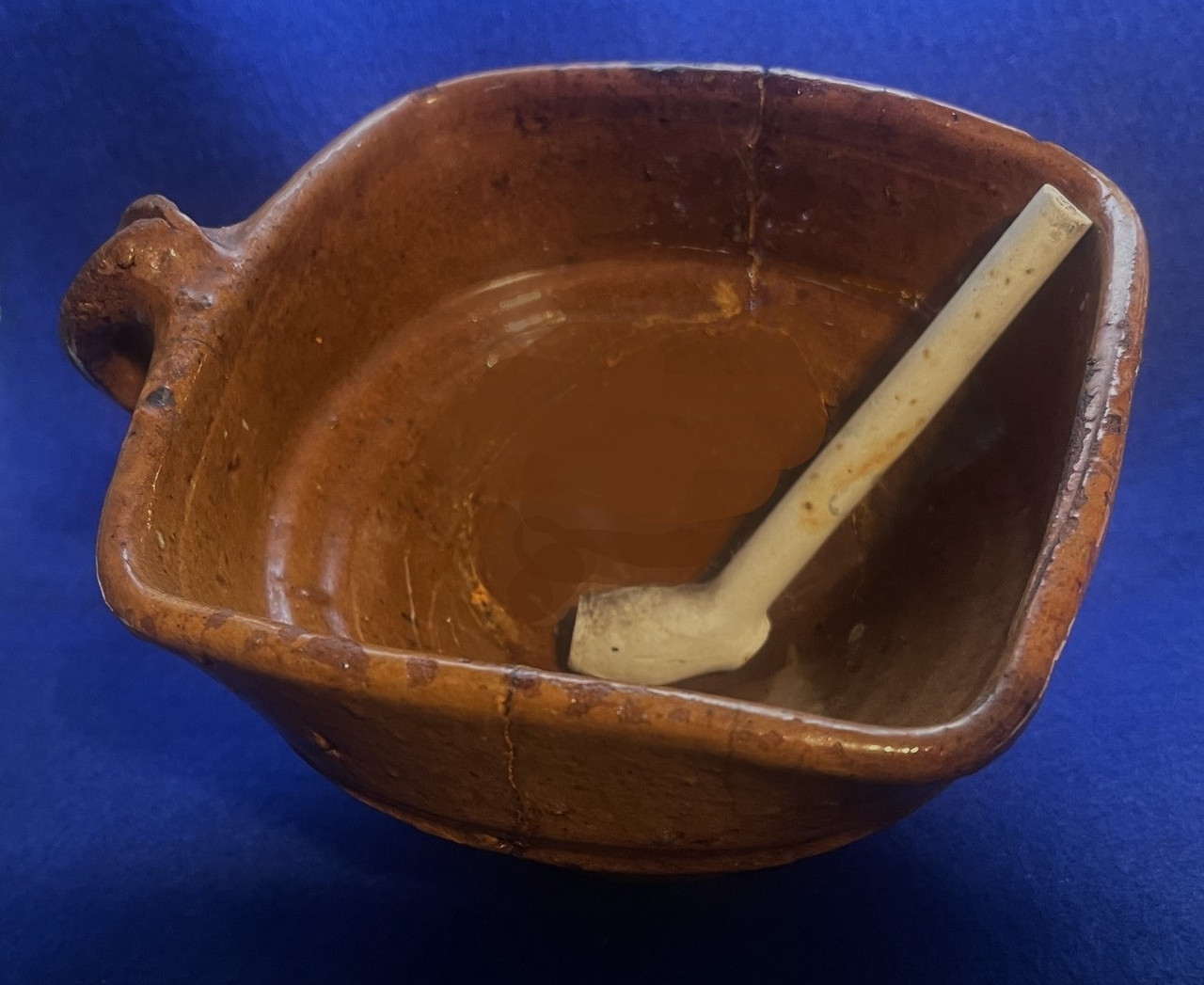


RARE – 17th – 18th century redware Tavern Pipe & Ash Bowl & pipe, circa 1685 – 1735

Product Description
This is another one of those very early pieces that you just never see. It is a rare redware Tavern Pipe & Ash Bowl, circa 1685 – 1735. It has the classic form of these encountered bowls, measuring 4” high, 3 1/4” diameter at the footed base, and the top opening is 5 ¼” x 5 1/4”, not counting for the handle. It has the typical glaze which covers the inside and was allowed to flow down the sides but not covering the entire clay.
Pipe bowls were used to hold pipes and their ashes on tavern tables in inns of the period. The form allowed for four stemmed pipes to rest in the corners. The pipes would be tapped along the inside to release the ashes.
In the 18th century, "redware" typically referred to both glazed and unglazed red earthenware, sometimes mixed with lighter tones, a common and affordable pottery material used for everyday items like cooking vessels and tableware. The color to which clay turns when fired varies considerably with its geological makeup and the conditions of firing.
It was particularly prevalent in colonial North America, where it was produced locally using readily available red clay. Redware forms included jugs, teapots, vases, bowls, and jars, at times decorated with some hand-painted motifs. Pipe bowls can be seen in early paintings, which I show a few pictures.
As you can see in the pictures, there are some hairline cracks. However, the bowl was never separated into pieces. As a precaution, I put a bead of glue along the cracks just to make sure it never detaches. Actually, I do think that this lends character to the piece, it only makes sense that the tapping of pipes against the bowl would allow this to happen over time. Very few of these bowls survived considering the sometimes rowdiness of the early taverns.
Product Reviews
)