 Loading... Please wait...
-
Call us on (973) 810-2976
- My Account
- Gift Certificates
- Items / $0.00

All prices are in All prices are in USD
Categories
- Home
- Sold, Hold, Layaway items
- RARE - 1600s Pitcher from an important New York City site, circa 1630-1690 (ON HOLD,W)
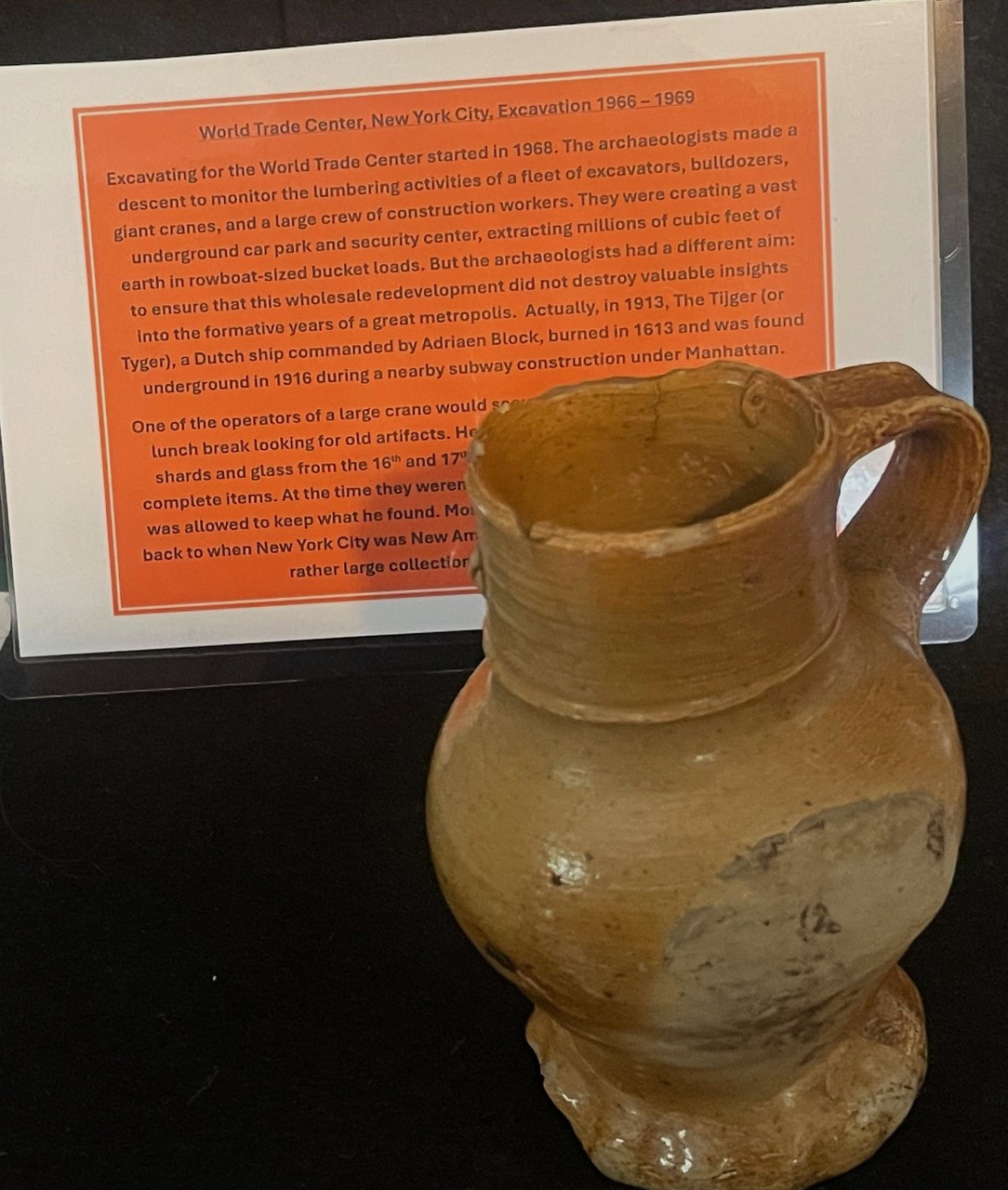


RARE - 1600s Pitcher from an important New York City site, circa 1630-1690 (ON HOLD,W)

Out of Stock
Product Description
Being offered is one of the items I recently spoke about – it is a small tan pitcher 5 ½” high, 4” wide, with a diameter of 2” on the top, and 3” on the bottom, circa 1630-1690. In the 1600s, pottery was primarily made from locally sourced, low-firing, iron-rich clays that fired to buff, red, or brown-tone colors. Common materials included clay, shale, and mudstones, often tempered with grog (crushed pottery), sand, or mica.
This pitcher was recovered in the late 1960s during the original excavating in New York City for the World Trade Center. One of the operators of a large crane would scour the recently dug ground on his lunch break looking for old artifacts. He said there were hundreds of broken shards and glass from the 16th and 17th century, but he was looking for more complete items. Actually, the Dutch ship “Tijger”, commanded by Adriaen Block, burned in 1613 and was found in 1916 during subway construction in the nearby area (see pictures).
At the time there were archaeologists on site, but didn’t consider these pieces as important artifacts, so he was usually allowed to keep what he found. Most items were early clay pottery, going back to when New York City was New Amsterdam. Over the years he acquired a rather large collection of these early pieces.
This substantial collection went to the man’s son, who just recently decided to part with some of these unique finds. The pitcher is in nice condition for its age, showing its crude manufacturing methods. It has some chips, as expected, but remains solid and has no repairs.
I was fortunate to acquire some objects from this rare collection and will begin listing them on the website. They are a very important part of America’s and New York City’s history. A laminated summary card and a Certificate of Authenticity will be included with every piece.
Product Reviews
, $285.00 (https://www.yankeerebelantiques.com/rare-1600s-pitcher-from-an-important-new-york-city-site-circa-1630-1690-on-hold-w/))