 Loading... Please wait...
-
Call us on (973) 810-2976
- My Account
- Gift Certificates
- Items / $0.00

All prices are in All prices are in USD
Categories
- Home
- Sold, Hold, Layaway items
- Framed Portrait of Peggy Shippen, wife of General Benedict Arnold (ON HOLD,MW)
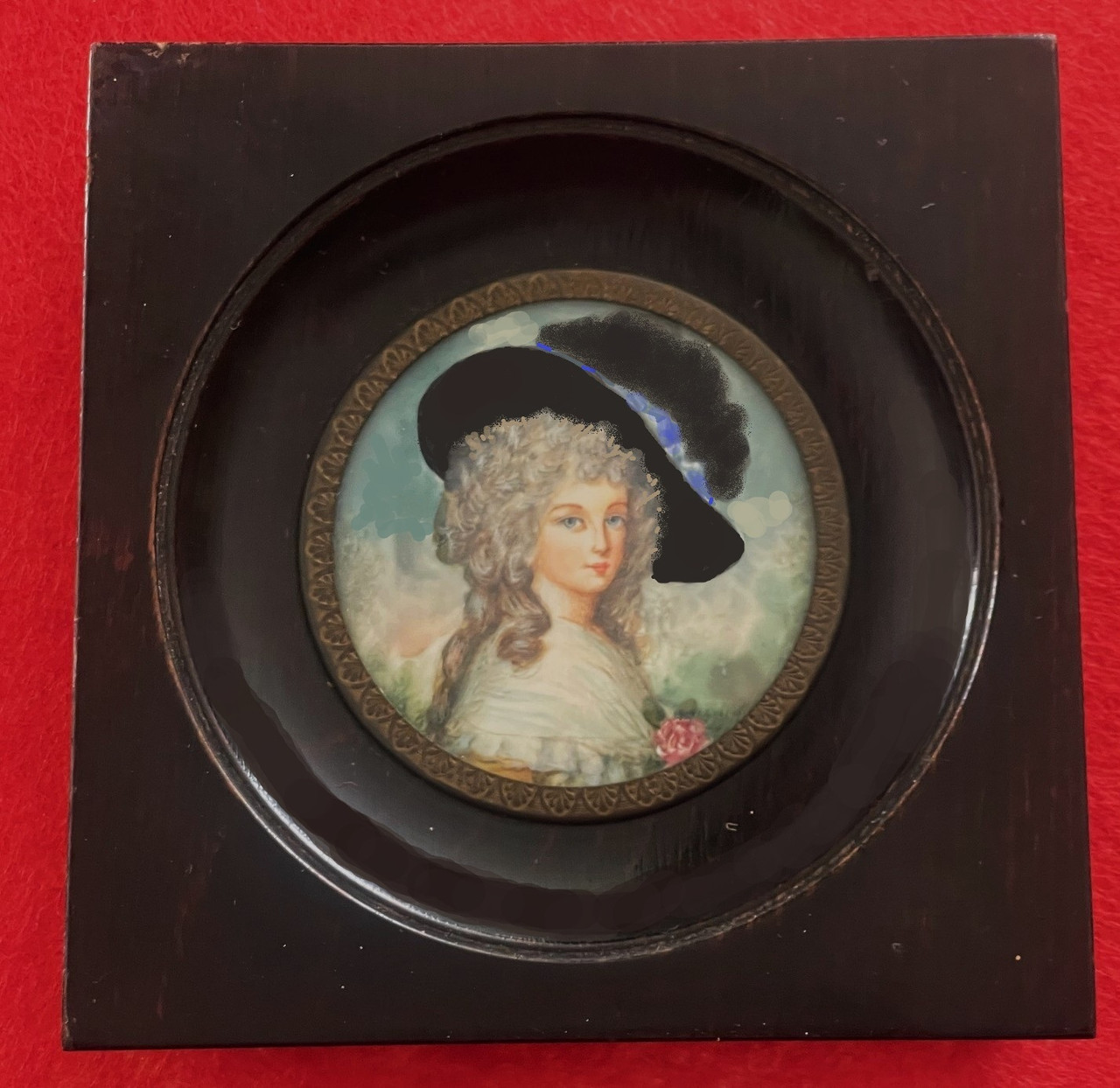


Framed Portrait of Peggy Shippen, wife of General Benedict Arnold (ON HOLD,MW)

Out of Stock
Product Description
This is another great piece being offered, it is a framed portrait of Peggy Shippen, wife of Benedict Arnold. The wooden frame overall measures 5 ¼” x 5 ¼” x ¾” and the oval portrait has a diameter of 3”.
Peggy (Margaret) Shippen (1760-1804) was the second wife of General Benedict Arnold. She has been described as "the highest-paid spy in the American Revolution". Shippen was born into a prominent Philadelphia family with Loyalist tendencies.
Her father was a merchant, judge, and member of the Provincial Council of Pennsylvania, ensuring that Peggy was surrounded by politics from an early age. She met Arnold during his tenure as military commander of the city following the British withdrawal in 1778.
They were married in the Shippen townhouse on Fourth Street in Philadelphia on April 8, 1779, and Arnold began conspiring with the British to change sides soon after. Peggy played a role in the conspiracy, which was exposed after British Major John André was arrested in September 1780 carrying documents concerning the planned surrender of the critical Continental Army base at West Point. Arnold escaped to New York City, and Peggy followed. They traveled together to London at the end of 1781, where she established a home and Arnold rebuilt a trading business.
On June 14, 1801, Benedict Arnold died, leaving Peggy to cope with their bad reputation and many debts. Three years later, on August 24, 1804, she died; survived by four sons and a daughter. She is buried with her husband at St. Mary’s Church, Battersea, in London. Although Peggy is not commemorated in Philadelphia, she and her husband remain infamous figures of the American Revolution. In “Collector’s Illustrated Encyclopedia of the American Revolution” by Neumann & Kravic, they show similar examples of these portraits (see pictures).
During the 18th century it was popular to have portraits of famous people, military, politicians, Generals, aristocrats, etc. Both famous artists and upcoming painters would have their renditions of these subjects – often copied from other painters. Typically, these small portraits would be painted on ivory.
Throughout history, war has been a constant presence, shaping civilizations and societies. From the earliest days of humanity, conflict has persisted in various forms, and based on historical patterns, it is likely to continue in some manner. This ongoing reality has given rise to a deep fascination among historians, museums, and collectors who seek to understand the past through the tangible remnants left behind, i.e. uniforms, guns, swords, artillery.
While significant attention is given to weapons and military gear, the everyday items used by soldiers frequently go unnoticed. Simple objects like forks, spoons, cups, dishes, pots, and knives played an essential role in a soldier’s daily life. These items were as precious to the individual as their weapon, serving practical needs and providing comfort amidst the hardships of war. I myself have always appreciated their importance in showing a complete representation in a collection. Bob
Product Reviews
, $285.00 (https://www.yankeerebelantiques.com/framed-portrait-of-peggy-shippen-wife-of-general-benedict-arnold-on-hold-mw/))