 Loading... Please wait...
-
Call us on (973) 810-2976
- My Account
- Gift Certificates
- Items / $0.00
All prices are in All prices are in USD
Categories
- Home
- Documents/Ephemera
- Civil War soldier's traveling inkwell with glass bottle insert
- Home
- Miscellaneous 19th Century
- Civil War soldier's traveling inkwell with glass bottle insert
- Home
- Non-excavated Artifacts
- Civil War soldier's traveling inkwell with glass bottle insert
- Home
- Personal Items
- Civil War soldier's traveling inkwell with glass bottle insert
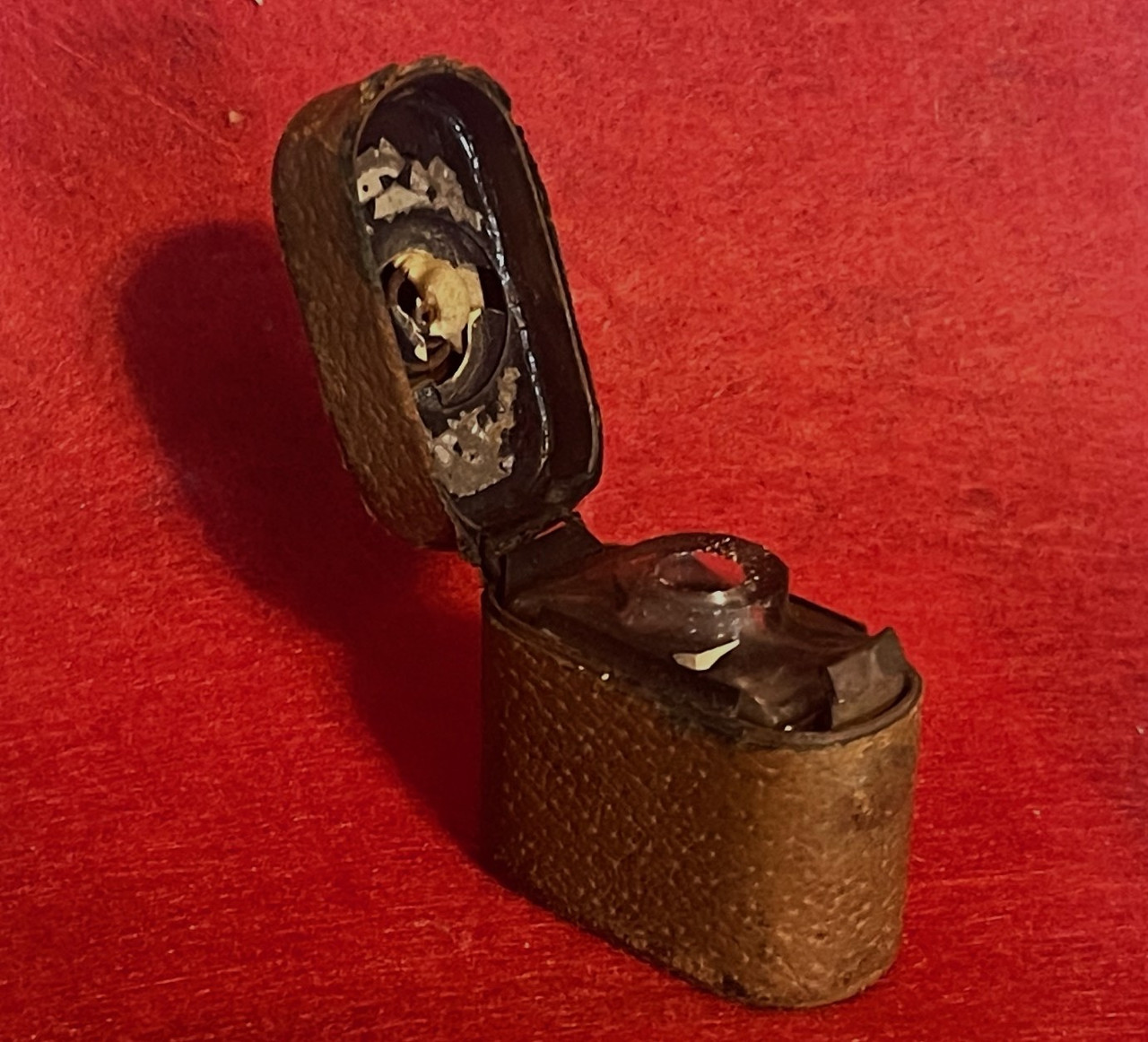


Civil War soldier's traveling inkwell with glass bottle insert

Product Description
This is another nice item being offered, it is an original Civil War Traveling Inkwell. It is made of tin with a brown leather covering. and brass with leather covering and measures 2” x 1 ¾” x 1”. There is a push button for opening and inside is a small glass bottle which would hold the ink and a rubber stopper on the lid to seal the bottle.
There was a rapid increase in the consumption of ink during the Civil War, accompanied by the required bottles and inkwells to store the ink. In the mid-1800's, excluding slaves, the population of the United States enjoyed having one of the highest literacy levels in the world.
The soldier was no longer at home, so his primary means of communication with his family was through letters. Soldiers went from writing occasional correspondence to writing letters home quite often. Those who were illiterate had one of his comrades do the writing for him.
In my book “The Civil War Soldier – His Personal Items”, I go into more detail on the importance of soldiers’ letter writing and showing a variety of inkwells. This size would be ideal for the average soldier, small enough to carry in his backpack or haversack, and were a popular item with camp sutlers. These inkwells go great with a display of a soldier’s personal effects, (particularly nice alongside a letter or with a pen). This specimen is a rare example and very difficult to find. It is in very nice condition and operates as expected.
Throughout history, war has been a constant presence, shaping civilizations and societies. From the earliest days of humanity, conflict has persisted in various forms, and based on historical patterns, it is likely to continue in some manner. This ongoing reality has given rise to a deep fascination among historians and collectors who seek to understand the past through the tangible remnants left behind, i.e. uniforms, guns, swords, artillery.
While significant attention is given to weapons and military gear, the everyday items used by soldiers frequently go unnoticed. Simple objects like forks, spoons, cups, dishes, pots, and knives played an essential role in a soldier’s daily life. These items were as precious to the individual as their weapon, serving practical needs and providing comfort amidst the hardships of war. I myself have always appreciated their importance in showing a complete representation of a collection. Bob
Product Reviews
)