 Loading... Please wait...
-
Call us on (973) 810-2976
- My Account
- Gift Certificates
- Items / $0.00

All prices are in All prices are in USD
Categories
- Home
- Medical Related Items
- 18th-century redware shaving bowl / blood bowl, ca. 1740 – 1780
- Home
- Identified Artifacts
- 18th-century redware shaving bowl / blood bowl, ca. 1740 – 1780
- Home
- Non-excavated Artifacts
- 18th-century redware shaving bowl / blood bowl, ca. 1740 – 1780
- Home
- Personal Items
- 18th-century redware shaving bowl / blood bowl, ca. 1740 – 1780
- Home
- Late 18th Century / Early 19th Century
- 18th-century redware shaving bowl / blood bowl, ca. 1740 – 1780
- Home
- Antiques from the 18th and 19th century
- 18th-century redware shaving bowl / blood bowl, ca. 1740 – 1780
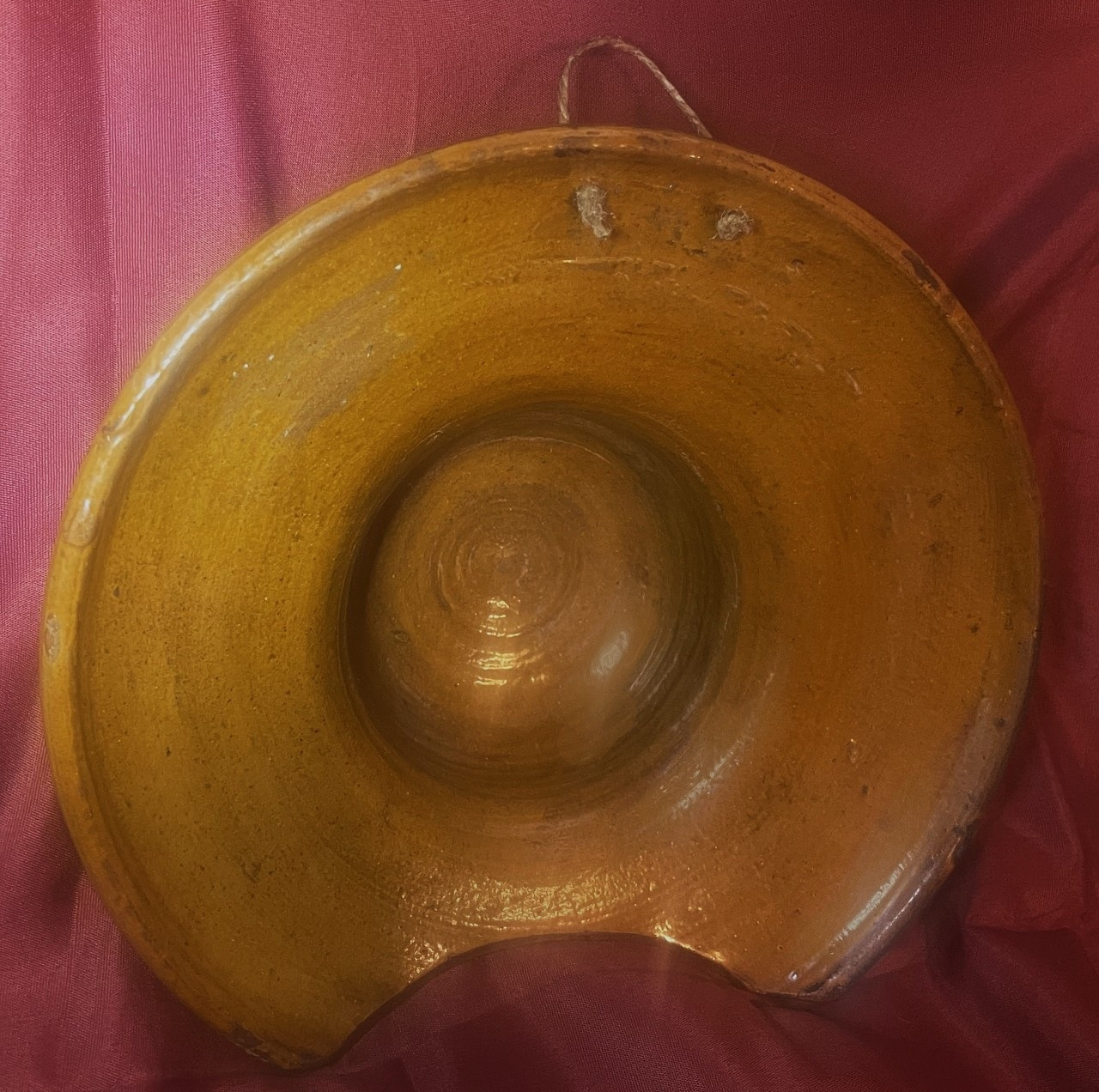


18th-century redware shaving bowl / blood bowl, ca. 1740 – 1780

Product Description
Being offered is a rare earthenware basin, usually referred to as a shaving bowl or blood bowl, circa 1740 – 1780. It has a diameter of 10” on top, 3 ¼” on the bottom, and stands 4” high. It has the typical semi-circle notch of the rim, which would be used to hold against the gentleman’s neck when shaving, or used to push against the arm if bloodletting. Often, barbers would visit military camps to perform such tasks.
It is made from local red clay, which is porous and requires a lead-based internal glaze (often clear or amber) to hold liquids safely. During the 18th century, barbers handled more than just hair; these basins were frequently used for wet shaving, hair trimming, and medical procedures like bloodletting, which they also performed.
While tin-glazed delftware and creamware shaving basins were common in 18th-century Europe and America, surviving regional redware examples from local potteries, such as those in Pennsylvania and New England are exceptionally scarce and highly prized by collectors.
Revolutionary War soldiers were clean-shaven because 18th-century social customs viewed beards as unrefined, and military discipline required a uniform, clean-cut appearance. Officers expected troops to maintain a neat appearance. General George Washington required soldiers in the Continental Army to shave multiple times a week, typically every three days.
This bowl is in beautiful condition, with no chips, cracks or repairs. It shows the typical flaws expected with 18th century redware, which adds to the appeal. The potter added two holes on the rim to hang the bowl when not in use. There are some forms of these bowls in just about all of the museums (see pictures).
Product Reviews
)