 Loading... Please wait...
-
Call us on (973) 810-2976
- My Account
- Gift Certificates
- Items / $0.00

All prices are in All prices are in USD
Categories
- Home
- NEW ITEMS
- 18th century English delftware plate decorated with Chinese figure of man with axe, ca. 1720 – 1750
- Home
- Photographs
- 18th century English delftware plate decorated with Chinese figure of man with axe, ca. 1720 – 1750
- Home
- Identified Artifacts
- 18th century English delftware plate decorated with Chinese figure of man with axe, ca. 1720 – 1750
- Home
- Non-excavated Artifacts
- 18th century English delftware plate decorated with Chinese figure of man with axe, ca. 1720 – 1750
- Home
- Personal Items
- 18th century English delftware plate decorated with Chinese figure of man with axe, ca. 1720 – 1750
- Home
- Late 18th Century / Early 19th Century
- 18th century English delftware plate decorated with Chinese figure of man with axe, ca. 1720 – 1750
- Home
- Revolutionary War items
- 18th century English delftware plate decorated with Chinese figure of man with axe, ca. 1720 – 1750
- Home
- Antiques from the 18th and 19th century
- 18th century English delftware plate decorated with Chinese figure of man with axe, ca. 1720 – 1750
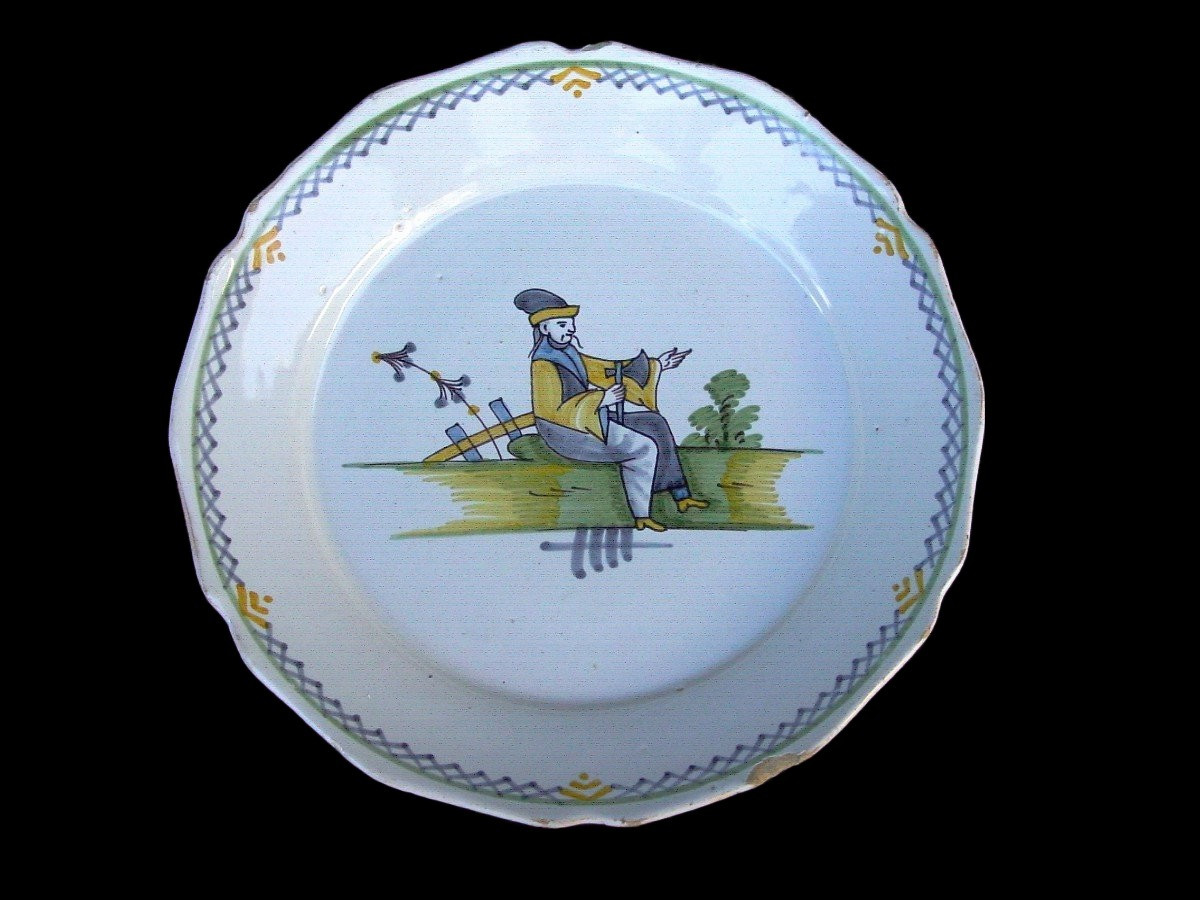


18th century English delftware plate decorated with Chinese figure of man with axe, ca. 1720 – 1750

Product Description
This beautiful English delftware dish is hand painted in yellow, green, and grey tones over white, depicting a Chinese man holding an axe. This early 18th century 9” plate has a scalloped rim with a green and yellow border. The talented artist captured a scene with elegant effects.
Delftware plates with Chinese figures are a tin-glazed earthenware ceramic from the Netherlands (or England/Europe mimicking it), featuring painted designs of scenes inspired by imported Chinese porcelain, a popular decorative style of the time period called “Chinoiserie” for its exotic appeal and beauty, showing figures reflecting the 17th-18th century craze for Asian aesthetics.
This place remains in very nice condition, only having a few minor chips on the rim, but they are hardly noticeable because of the scalloped rim. The back of the plate has no markings, which was typical of the early 18th century. The very tiny holes on the reverse resulted from the manufacturing process where gases escaped from the clay through the glaze – further validating the early process.
Shards of these plates are found at Revolutionary War sites, especially the forts (see pictures). This reveals their popularity at the time, and were probably used by officers, American, British and French. This rare dish would make a great addition to just about any collection.
Revolutionary War artifacts have always been difficult to find, and I am fortunate to have quite a few pieces in stock. With the upcoming of the 250th anniversary of the nation's founding next year, there will be a revitalized interest. Just about all Revolutionary War relics and artifacts will be in demand, which will only add to their scarcity and price. I am already seeing a substantial increase in purchases.
Throughout history, war has been a constant presence, shaping civilizations and societies. From the earliest days of humanity, conflict has persisted in various forms, and based on historical patterns, it is likely to continue in some manner. This ongoing reality has given rise to a deep fascination among historians and collectors who seek to understand the past through the tangible remnants left behind, i.e. uniforms, guns, swords, artillery.
While significant attention is given to weapons and military gear, the everyday items used by soldiers frequently go unnoticed. Simple objects like forks, spoons, cups, dishes, pots, and knives played an essential role in a soldier’s daily life. These items were as precious to the individual as their weapon, serving practical needs and providing comfort amidst the hardships of war. I myself have always appreciated their importance in showing a complete representation of a collection. Bob
Product Reviews
)