 Loading... Please wait...
-
Call us on (973) 810-2976
- My Account
- Gift Certificates
- Items / $0.00
All prices are in All prices are in USD
Categories
- Home
- Personal Items
- 18th century Earthenware jug/pitcher, out of an upstate New York collection
- Home
- Late 18th Century / Early 19th Century
- 18th century Earthenware jug/pitcher, out of an upstate New York collection
- Home
- Revolutionary War items
- 18th century Earthenware jug/pitcher, out of an upstate New York collection
- Home
- Antiques from the 18th and 19th century
- 18th century Earthenware jug/pitcher, out of an upstate New York collection


18th century Earthenware jug/pitcher, out of an upstate New York collection

Product Description
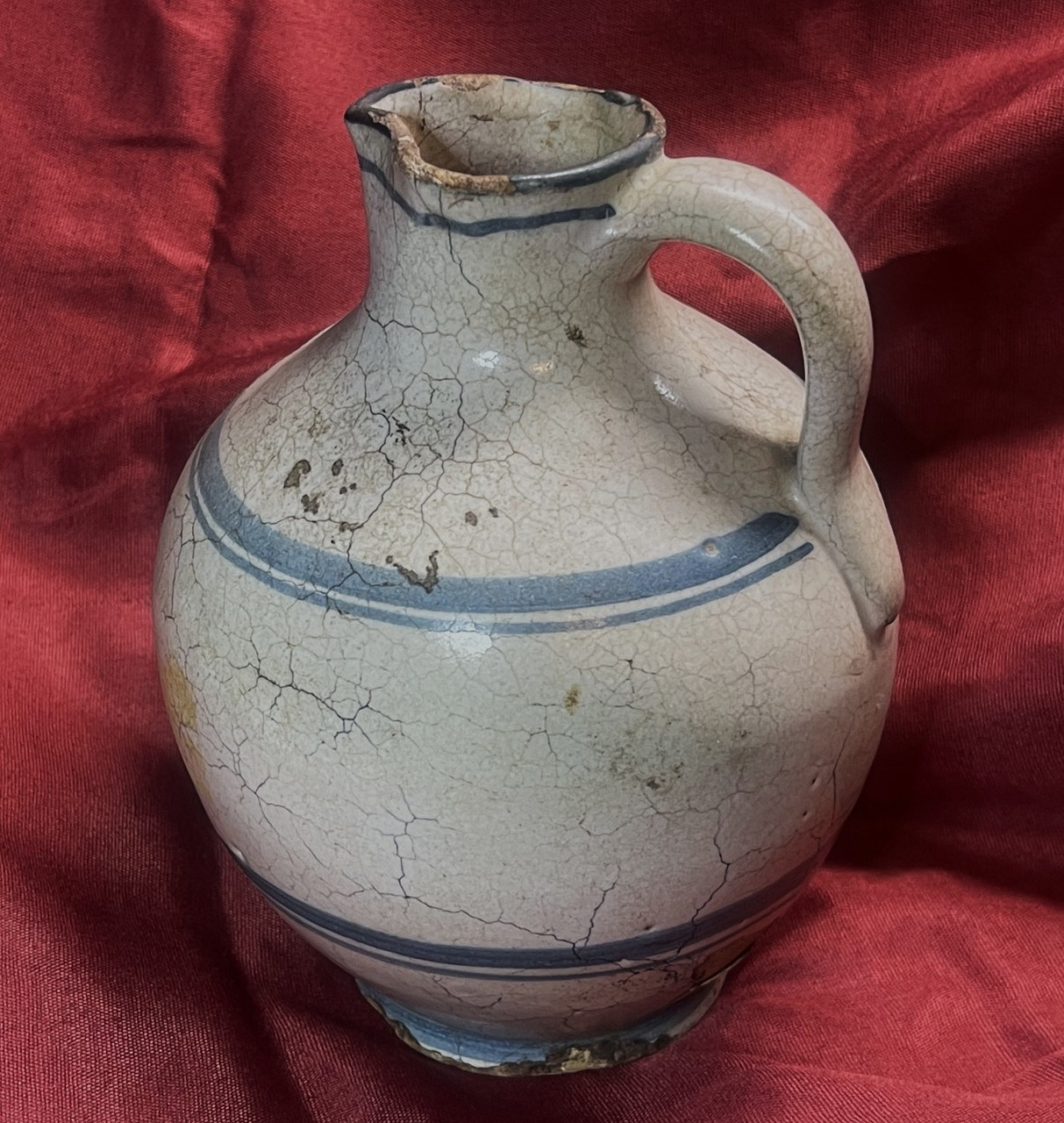
Being offered is a tin-glazed earthenware pitcher, ca. 1750 – 1780, (often referred to as faience or maiolica) having distinct decorative and structural characteristics. It is 7” high x 4 ½” in the center, and a diameter of 2 ¾” at the base.
Being of earthenware or terracotta coated, it has an opaque white/off-white tin glaze. The heavy fine network of lines across the surface is crazing, which occurs over time as the ceramic body and glaze expand and contract at different rates.
It has simple hand-painted cobalt blue horizontal bands/stripes encircling the lip, shoulder, body, and base. The rounded, bulbous body tapers into a pinched pour spout and a sturdy loop handle. They were also common in 18th century taverns.
Because of its age, there is some flaking and glaze loss. The dark brown/buff-colored patches on the side and base are areas where the tin-glaze enamel has chipped or flaked off, exposing the underlying fired clay body.
Pottery of this style was utilitarian earthenware with simple blue banded decoration, which was produced in France and England and brought over to the American colonies during the Revolutionary War era. There are shards of these vessels found at Revolutionary War sites. This pitcher remains solid and really has a great look with its flaws and age. It came out of a Revolutionary War collection in upstate New York – much of it was military, but there was still quite a few personal items.
Product Reviews
)